Definition in file fancynorm.H.
#include "Util/log.H"
#include <string>
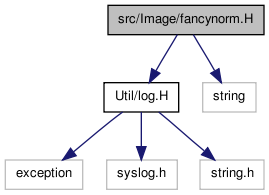
Include dependency graph for fancynorm.H:

This graph shows which files directly or indirectly include this file:

Go to the source code of this file.
Types of normalization (normtyp) | |
| #define | NBMAXNORMTYPES 13 |
| #define | VCXNORM_DEFAULT VCXNORM_FANCY |
| enum | MaxNormType { VCXNORM_NONE = 0, VCXNORM_MAXNORM = 1, VCXNORM_FANCY = 2, VCXNORM_FANCYFAST = 3, VCXNORM_FANCYONE = 4, VCXNORM_FANCYLANDMARK = 5, VCXNORM_LANDMARK = 6, VCXNORM_FANCYWEAK = 7, VCXNORM_IGNORE = 8, VCXNORM_SURPRISE = 9, VCXNORM_FANCYVWEAK = 10, VCXNORM_STDEV = 11, VCXNORM_STDEV0 = 12 } |
| const char * | maxNormTypeName (const MaxNormType m) |
| Get a name in clear for a given type. | |
Additional parameters for fancynorm versions of the algorithm. | |
| const int | FANCYITER = 5 |
| default number of iterations | |
| const double | FANCYESIG = 2 |
| excitatory sigma as % of image size | |
| const double | FANCYISIG = 25 |
| inhibitory sigma as % of image size | |
| const double | FANCYCOEX = 0.5 |
| excitatory coefficient (strength) | |
| const double | FANCYCOIN = 1.5 |
| inhibitory coefficient (strength) | |
| const double | FANCYINHI = 2.0 |
| strength of global inhibition | |
| const double | FANCYG = 2.1 |
| for sigmoid normalization | |
| const double | FANCYH = 2.0 |
| for sigmoid normalization | |
| const double | FANCYS = 1.0 |
| for sigmoid normalization | |
| const int | LRLEVEL = 2 |
| for tuned long-range excitation: | |
Standard min/max bounds for maxNormalize(). | |
| const float | MAXNORMMAX = 10.0f |
| upper bound for maxNormalize() | |
| const float | MAXNORMMIN = 0.0f |
| lower bound for maxNormalize() | |
| const float | MAXNORMLANDMARK = 255.0f |
| upper bound for maxNormalizeFancyLandmark() | |
Functions | |
| template<class T> | |
| Image< T > | maxNormalize (const Image< T > &src, const T mi, const T ma, const MaxNormType normtyp=VCXNORM_DEFAULT, int nbiter=FANCYITER, const Image< float > *lrexcit=0) |
| Generic implementation (select algorithm with normtyp). | |
| template<class T> | |
| Image< T > | maxNormalizeNone (const Image< T > &src, const T mi, const T ma) |
| Specialized implementation (corresponds to VCXNORM_NONE). | |
| template<class T> | |
| Image< T > | maxNormalizeStd (const Image< T > &src, const T mi, const T ma) |
| Specialized implementation (corresponds to VCXNORM_MAXNORM). | |
| template<class T> | |
| Image< T > | maxNormalizeFancyFast (const Image< T > &src, const T mi, const T ma, const int nbiter=FANCYITER) |
| Specialized implementation (corresponds to VCXNORM_FANCYFAST). | |
| template<class T> | |
| Image< T > | maxNormalizeFancy (const Image< T > &src, const T mi, const T ma, const int nbiter=FANCYITER, const double weakness=1.0, const Image< float > *lrexcit=0) |
| Specialized implementation (corresponds to VCXNORM_FANCY). | |
| template<class T> | |
| Image< T > | maxNormalizeFancyLandmark (const Image< T > &src, const T mi, const T ma, const int nbiter=FANCYITER) |
| Specialized implementation (corresponds to VCXNORM_FANCY). | |
| template<class T> | |
| Image< T > | maxNormalizeLandmark (const Image< T > &src, const T mi, const T ma) |
| Specialized implementation (corresponds to VCXNORM_LANDMARK). | |
| template<class T> | |
| int | findPeaks (const Image< T > &src, const T mi, const T ma, double &sum) |
| to find number of peaks in the image (used in landmark detection) | |
| template<class T> | |
| float | goodness_map (const Image< T > &src) |
| to find the goodness of a map (used in landmark detection) | |
| template<class T> | |
| Image< T > | maxNormalizeStdev (const Image< T > &src) |
| Specialized implementation (corresponds to VCXNORM_STDEV). | |
| template<class T> | |
| Image< T > | maxNormalizeStdev0 (const Image< T > &src) |
| Specialized implementation (corresponds to VCXNORM_STDEV0). | |
| std::string | convertToString (const MaxNormType val) |
| MaxNormType overload. | |
| void | convertFromString (const std::string &str, MaxNormType &val) |
| MaxNormType overload. | |
|
|
Have this value always equal to the largest of the VCXNORMs (used for range checking) Definition at line 70 of file fancynorm.H. Referenced by convertFromString(), and maxNormTypeName(). |
|
|
Always points to the default maxnorm operation Definition at line 88 of file fancynorm.H. Referenced by main(). |
|
|
Definition at line 51 of file fancynorm.H. |
|
||||||||||||
|
MaxNormType overload. Format is "name" as defined by maxNormTypeName() in MaxNormTypes.H Definition at line 638 of file fancynorm.C. References GVX_TRACE, i, maxNormTypeName(), and NBMAXNORMTYPES. |
|
|
MaxNormType overload. Format is "name" as defined by maxNormTypeName() in MaxNormTypes.H Definition at line 632 of file fancynorm.C. References GVX_TRACE, and maxNormTypeName(). |
|
||||||||||||||||||||||||
|
to find number of peaks in the image (used in landmark detection)
Definition at line 484 of file fancynorm.C. References area, findMax(), GVX_TRACE, rutz::max(), maxNormalize(), segmentLandmark(), target, and VCXNORM_FANCY. Referenced by goodness_map(), maxNormalizeLandmark(), SimulationViewerStats::save1(), and SimulationViewerNerdCam::writeStatusPage(). |
|
||||||||||
|
to find the goodness of a map (used in landmark detection)
Definition at line 518 of file fancynorm.C. References ASSERT, findMax(), findPeaks(), goodness_map(), GVX_TRACE, Image< T >::initialized(), inplaceNormalize(), LINFO, rutz::max(), MAXNORMLANDMARK, MAXNORMMIN, segmentLandmark(), and target. Referenced by ComplexChannel::combineOutputs(), SingleChannel::combineSubMaps(), goodness_map(), and maxNormalizeLandmark(). |
|
||||||||||||||||||||||||||||||||
|
Generic implementation (select algorithm with normtyp). Normalize between mi and ma and multiply by (ma - mean). Versions with more arguments implement the core within-feature spatial competition for salience. See papers for details. |
|
||||||||||||||||||||||||||||||||
|
Specialized implementation (corresponds to VCXNORM_FANCY). fancyNorm from Itti et al, JEI, 2001; FULL implementation. |
|
||||||||||||||||||||||||
|
Specialized implementation (corresponds to VCXNORM_FANCYFAST). fancyNorm from Itti et al, JEI, 2001; FAST implementation. Definition at line 206 of file fancynorm.C. References ASSERT, buildPyrGaussian(), FANCYCOEX, FANCYCOIN, FANCYESIG, FANCYINHI, FANCYISIG, getMinMax(), GVX_TRACE, h, i, Image< T >::initialized(), inplaceAttenuateBorders(), inplaceNormalize(), inplaceRectify(), log(), rutz::max(), rescale(), sqrt(), and w. Referenced by maxNormalize(). |
|
||||||||||||||||||||||||
|
Specialized implementation (corresponds to VCXNORM_FANCY). fancyNorm from Itti et al, JEI, 2001; FULL implementation. adapted to find landmarks Definition at line 331 of file fancynorm.C. References ASSERT, CONV_BOUNDARY_CLEAN, FANCYCOEX, FANCYCOIN, FANCYINHI, getMinMax(), GVX_TRACE, h, i, Image< T >::initialized(), inplaceNormalize(), inplaceRectify(), rutz::max(), rutz::min(), sepFilter(), sqrt(), and w. Referenced by maxNormalize(). |
|
||||||||||||||||||||
|
Specialized implementation (corresponds to VCXNORM_LANDMARK). to find landmarks Definition at line 382 of file fancynorm.C. References ASSERT, findMax(), findPeaks(), Image< T >::getDims(), Image< T >::getVal(), goodness_map(), GVX_TRACE, Image< T >::initialized(), inplaceNormalize(), LINFO, rutz::max(), MAXNORMLANDMARK, MAXNORMMIN, Image< T >::resize(), segmentLandmark(), and target. Referenced by maxNormalize(). |
|
||||||||||||||||||||
|
Specialized implementation (corresponds to VCXNORM_NONE). No max-normalization, just normalize between mi and ma. Definition at line 130 of file fancynorm.C. References GVX_TRACE, inplaceNormalize(), and inplaceRectify(). Referenced by maxNormalize(). |
|
||||||||||||||||||||
|
Specialized implementation (corresponds to VCXNORM_MAXNORM). maxNorm from Itti et al, IEEE-PAMI, 1998. Definition at line 147 of file fancynorm.C. References ASSERT, GVX_TRACE, h, i, Dlist::index(), Image< T >::initialized(), inplaceNormalize(), inplaceRectify(), and w. Referenced by maxNormalize(). |
|
||||||||||
|
Specialized implementation (corresponds to VCXNORM_STDEV). The output image is the result of normalizing the input image to have stdev=1 and minval=0, by simply dividing by the stdev of the original image and then subtracting the minval of the resulting image. We set minval=0, rather than the more natural mean=0, because maxNormalize functions traditionally return images with only non-negative values, since negative values will likely eventually be subject to a rectification. The choice of minval=0 or mean=0 has no effect on the statistics of maps produced by summing several stdev-normalized maps; the resulting map itself will have the same stdev in either case, and the only difference will be a shift in its mean. Definition at line 586 of file fancynorm.C. References Image< T >::getDims(), getMinMax(), s, stdev(), and ZEROS. Referenced by maxNormalize(). |
|
||||||||||
|
Specialized implementation (corresponds to VCXNORM_STDEV0). The output image is the result of normalizing the input image to have mean=0 and stdev=1, by simply subtracting the mean of the original image and then dividing by the stdev of the original image. Beware that the resulting image will have negative values, which may be truncated by later rectification steps. Definition at line 608 of file fancynorm.C. References Image< T >::getDims(), mean(), s, stdev(), u(), and ZEROS. Referenced by maxNormalize(). |
|
|
Get a name in clear for a given type.
Definition at line 73 of file fancynorm.H. References LFATAL, n, and NBMAXNORMTYPES. Referenced by ComplexChannel::combineOutputs(), IntegerComplexChannel::combineOutputsInt(), SingleChannel::combineSubMaps(), HueChannel::combineSubMaps(), convertFromString(), convertToString(), IntegerSimpleChannel::getOutputInt(), IntegerSimpleChannel::getSubmapInt(), SingleChannel::postProcessMap(), VisualCortexSurprise::postProcessOutputMap(), RawVisualCortex::postProcessOutputMap(), and IntegerRawVisualCortex::postProcessOutputMap(). |
|
|
excitatory coefficient (strength)
Definition at line 97 of file fancynorm.H. Referenced by cudaMaxNormalizeFancy(), maxNormalizeFancy(), maxNormalizeFancyFast(), and maxNormalizeFancyLandmark(). |
|
|
inhibitory coefficient (strength)
Definition at line 98 of file fancynorm.H. Referenced by cudaMaxNormalizeFancy(), maxNormalizeFancy(), maxNormalizeFancyFast(), and maxNormalizeFancyLandmark(). |
|
|
excitatory sigma as % of image size
Definition at line 95 of file fancynorm.H. Referenced by cudaMaxNormalizeFancy(), maxNormalizeFancy(), and maxNormalizeFancyFast(). |
|
|
for sigmoid normalization
Definition at line 101 of file fancynorm.H. |
|
|
for sigmoid normalization
Definition at line 102 of file fancynorm.H. |
|
|
strength of global inhibition
Definition at line 99 of file fancynorm.H. Referenced by cudaMaxNormalizeFancy(), maxNormalizeFancy(), maxNormalizeFancyFast(), and maxNormalizeFancyLandmark(). |
|
|
inhibitory sigma as % of image size
Definition at line 96 of file fancynorm.H. Referenced by cudaMaxNormalizeFancy(), maxNormalizeFancy(), and maxNormalizeFancyFast(). |
|
|
default number of iterations
Definition at line 94 of file fancynorm.H. |
|
|
for sigmoid normalization
Definition at line 103 of file fancynorm.H. |
|
|
for tuned long-range excitation:
Definition at line 105 of file fancynorm.H. Referenced by cudaMaxNormalizeFancy(), and maxNormalizeFancy(). |
|
|
upper bound for maxNormalizeFancyLandmark()
Definition at line 117 of file fancynorm.H. Referenced by goodness_map(), and maxNormalizeLandmark(). |
|
|
1.4.4