
#include "Image/ConvolutionMap.H"#include "rutz/trace.h"#include <algorithm>#include <cmath>#include "inst/Image/ConvolutionMap.I"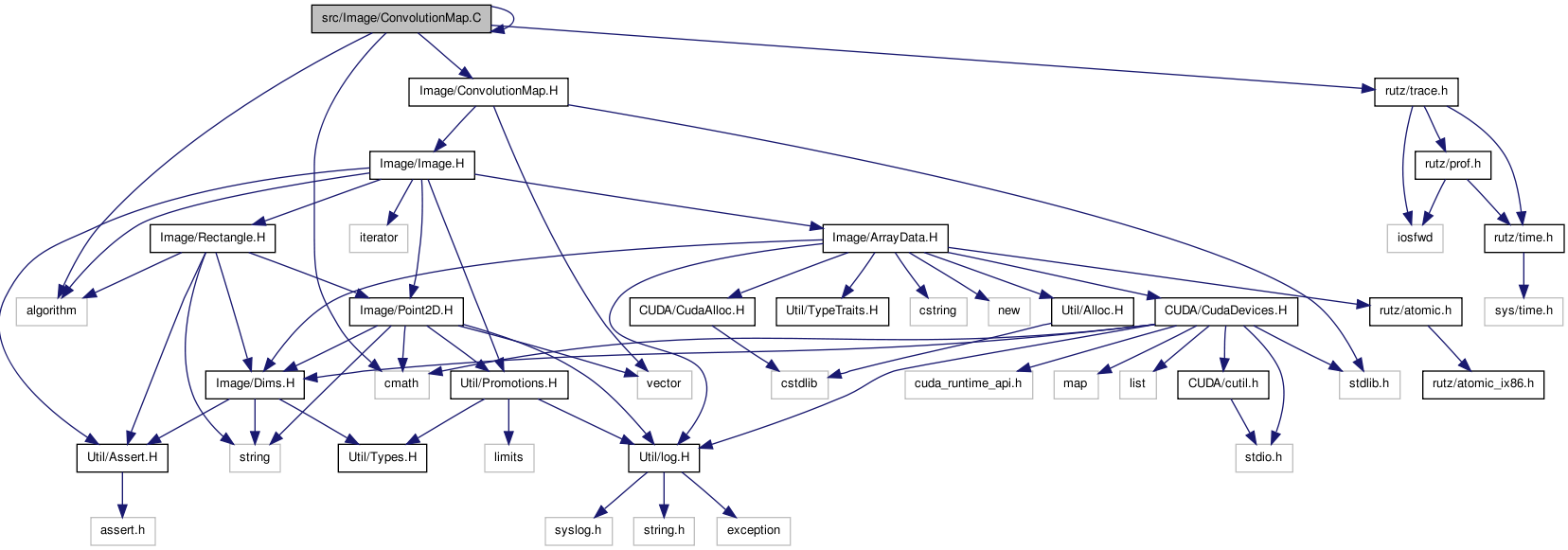

Go to the source code of this file.
Functions | |
| template<class T > | |
| void | computeConvolutionMaps (convolutionMap< T > &cMap) |
| Computes a set of convolution maps for doing multiple convolutions. | |
| template<class T > | |
| Image< T > | convolveWithMaps (convolutionMap< T > &cMap) |
| carries out a simple mapped convolution, call computeConvolutionMaps first | |
Definition in file ConvolutionMap.C.
| void computeConvolutionMaps | ( | convolutionMap< T > & | cMap | ) | [inline] |
Computes a set of convolution maps for doing multiple convolutions.
When doing more than one convolution, for instance on an animated sequence, this builds a map set so that we precompute (A) border regions (B) very small kernel values These are removed and a vector of indexes is produced. These can then be used by iterating over the maps which contain the index.
| cMap | This is a container for the maps and images used |
Definition at line 47 of file ConvolutionMap.C.
References convolutionMap< T >::CMcheckInit1(), convolutionMap< T >::CMimageArrayHandle, convolutionMap< T >::CMimageMap, convolutionMap< T >::CMindexMap, convolutionMap< T >::CMinit2, convolutionMap< T >::CMinitVecSize, convolutionMap< T >::CMkernel, convolutionMap< T >::CMkernelMap, convolutionMap< T >::CMkWeightNorm, convolutionMap< T >::CMorigImage, convolutionMap< T >::CMsmallNumber, convolutionMap< T >::CMstaticImage, Image< T >::getVal(), Image< T >::getWidth(), Image< T >::resize(), and Image< T >::setVal().
| Image<T> convolveWithMaps | ( | convolutionMap< T > & | cMap | ) | [inline] |
carries out a simple mapped convolution, call computeConvolutionMaps first
This will take in the convolution maps created and the current image and compute convolution in a line. That is, for each pixel we can in a straight line iterate over all the image and kernel values using a map. This saves us from having to check for border regions and compute pixel locations. Additionally, we can pre-remove small values from convolution.
| cMap | This is a contaner for maps and images Example use: |
convolutionMap<FLOAT> cMap; Image<float> inputImg;
...
if(frame == 1) { readMatrix rm("lowPassKernel.mat"); rm.echoMatrix(); cMap.CMsmallNumber = 1.1F; cMap.CMinitVecSize = 1; cMap.CMkernel = rm.returnMatrixAsImage(); cMap.CMorigImage = inputImg; computeConvolutionMaps(cMap); } cMap.CMcopyImage(inputImg); Image<FLOAT> i2 = convolveWithMaps(cMap);
Definition at line 156 of file ConvolutionMap.C.
References Image< T >::begin(), Image< T >::beginw(), convolutionMap< T >::CMcheckInit2(), convolutionMap< T >::CMimageMap, convolutionMap< T >::CMindexMap, convolutionMap< T >::CMkernelMap, convolutionMap< T >::CMkWeightNorm, convolutionMap< T >::CMpreciseVectors, convolutionMap< T >::CMstaticImage, Image< T >::end(), and ZEROS.
 1.6.3
1.6.3