
#include "Component/ModelManager.H"#include "Devices/DeviceOpts.H"#include "Devices/FrameGrabberConfigurator.H"#include "Devices/FrameGrabberFactory.H"#include "GUI/XWindow.H"#include "Image/DrawOps.H"#include "Image/Image.H"#include "Image/Pixels.H"#include "Util/Timer.H"#include "Util/log.H"#include "Util/sformat.H"#include <vector>#include <cstdio>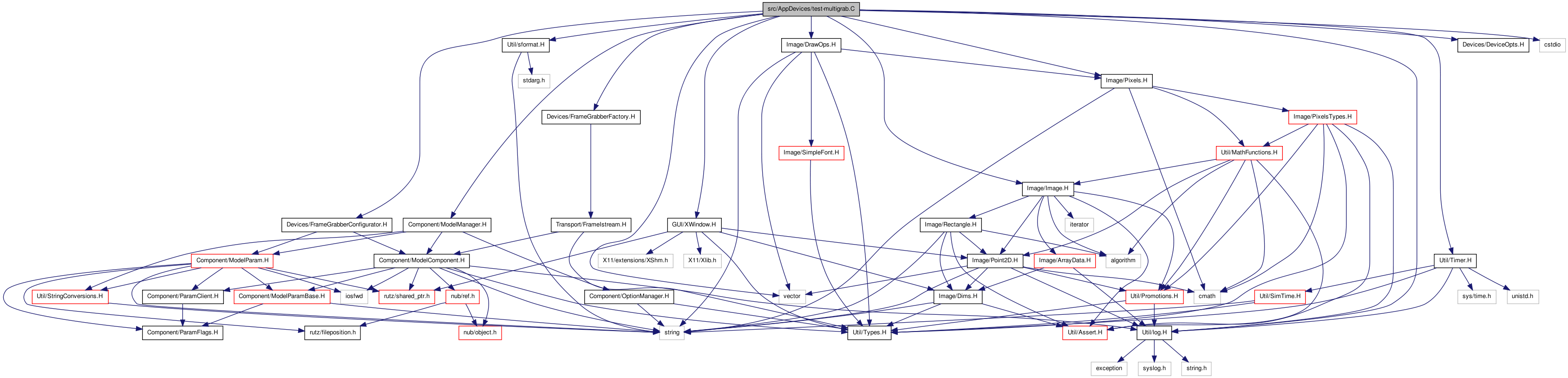
Go to the source code of this file.
Defines | |
| #define | NAVG 20 |
Functions | |
| int | main (const int argc, const char **argv) |
Test multiple frame grabbing and X display
Definition in file test-multigrab.C.
| int main | ( | const int | argc, | |
| const char ** | argv | |||
| ) |
This simple executable tests multiple video frame grabbing through either the video4linux2 driver (see V4L2grabber.H; when you specify --fg-type=V4L2 and then give the pathnames of V4L2 devices as arguments), or IEEE1394 (see IEEE1394grabber.H; when you specify --fg-type=1394 and pass the camera (subchannel) numbers as arguments).
Definition at line 61 of file test-multigrab.C.
References ModelComponent::addSubComponent(), XWindow::drawImage(), ModelComponent::exportOptions(), Timer::get(), ModelManager::getExtraArg(), ModelManager::getOptionValString(), makeIEEE1394grabber(), makeV4L2grabber(), MC_RECURSE, ModelManager::numExtraArgs(), ModelManager::parseCommandLine(), ModelComponent::removeSubComponent(), Timer::reset(), nub::soft_ref< T >::reset(), sformat(), ModelComponent::start(), and ModelComponent::stop().
 1.6.3
1.6.3