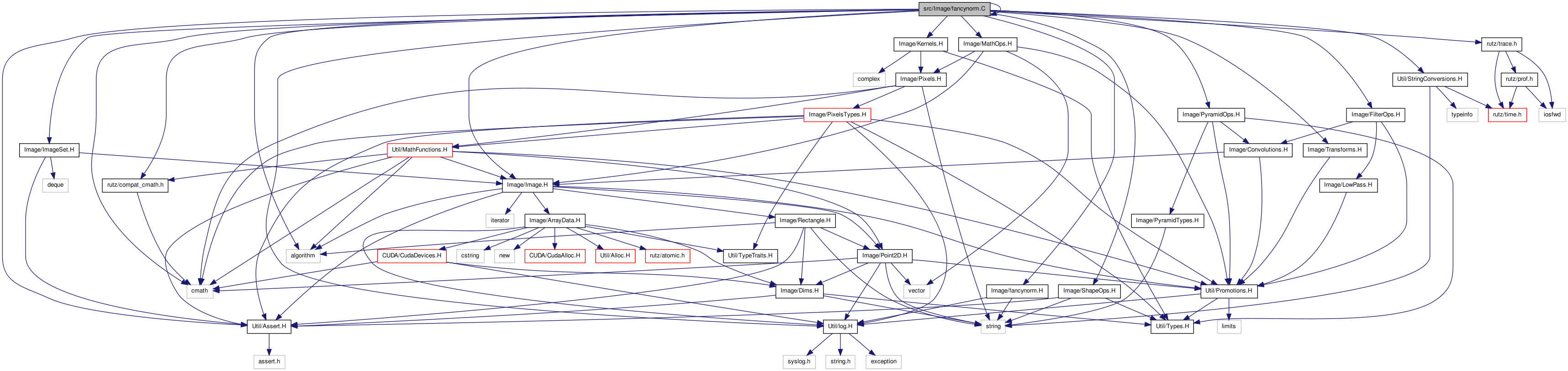
Definition in file fancynorm.C.
#include "Image/fancynorm.H"
#include "Util/Assert.H"
#include "Image/Image.H"
#include "Image/ImageSet.H"
#include "Image/FilterOps.H"
#include "Image/Kernels.H"
#include "Image/MathOps.H"
#include "Image/ShapeOps.H"
#include "Image/Transforms.H"
#include "Image/PyramidOps.H"
#include "Util/StringConversions.H"
#include "Util/log.H"
#include "rutz/compat_cmath.h"
#include "rutz/trace.h"
#include <algorithm>
#include <cmath>
#include "inst/Image/fancynorm.I"
Include dependency graph for fancynorm.C:

Go to the source code of this file.
Functions | |
| template<class T> | |
| Image< T > | maxNormalize (const Image< T > &src, const T mi, const T ma, const MaxNormType normtyp, int nbiter, const Image< float > *lrexcit) |
| template<class T> | |
| Image< T > | maxNormalizeNone (const Image< T > &src, const T mi, const T ma) |
| Specialized implementation (corresponds to VCXNORM_NONE). | |
| template<class T> | |
| Image< T > | maxNormalizeStd (const Image< T > &src, const T mi, const T ma) |
| Specialized implementation (corresponds to VCXNORM_MAXNORM). | |
| template<class T> | |
| Image< T > | maxNormalizeFancyFast (const Image< T > &src, const T mi, const T ma, const int nbiter) |
| Specialized implementation (corresponds to VCXNORM_FANCYFAST). | |
| template<class T> | |
| Image< T > | maxNormalizeFancy (const Image< T > &src, const T mi, const T ma, const int nbiter, const double weakness, const Image< float > *lrexcit) |
| template<class T> | |
| Image< T > | maxNormalizeFancyLandmark (const Image< T > &src, const T mi, const T ma, const int nbiter) |
| Specialized implementation (corresponds to VCXNORM_FANCY). | |
| template<class T> | |
| Image< T > | maxNormalizeLandmark (const Image< T > &src, const T mi, const T ma) |
| Specialized implementation (corresponds to VCXNORM_LANDMARK). | |
| template<class T> | |
| int | findPeaks (const Image< T > &src, const T mi, const T ma, double &sum_activity) |
| to find number of peaks in the image (used in landmark detection) | |
| template<class T> | |
| float | goodness_map (const Image< T > &src) |
| to find the goodness of a map (used in landmark detection) | |
| template<class T> | |
| Image< T > | maxNormalizeStdev (const Image< T > &src) |
| Specialized implementation (corresponds to VCXNORM_STDEV). | |
| template<class T> | |
| Image< T > | maxNormalizeStdev0 (const Image< T > &src) |
| Specialized implementation (corresponds to VCXNORM_STDEV0). | |
| std::string | convertToString (const MaxNormType val) |
| MaxNormType overload. | |
| void | convertFromString (const std::string &str, MaxNormType &val) |
| MaxNormType overload. | |
|
||||||||||||
|
MaxNormType overload. Format is "name" as defined by maxNormTypeName() in MaxNormTypes.H Definition at line 638 of file fancynorm.C. |
|
|
MaxNormType overload. Format is "name" as defined by maxNormTypeName() in MaxNormTypes.H Definition at line 632 of file fancynorm.C. |
|
||||||||||||||||||||||||
|
to find number of peaks in the image (used in landmark detection)
Definition at line 484 of file fancynorm.C. References area, findMax(), GVX_TRACE, rutz::max(), maxNormalize(), segmentLandmark(), target, and VCXNORM_FANCY. Referenced by goodness_map(), maxNormalizeLandmark(), SimulationViewerStats::save1(), and SimulationViewerNerdCam::writeStatusPage(). |
|
||||||||||
|
to find the goodness of a map (used in landmark detection)
Definition at line 518 of file fancynorm.C. References ASSERT, findMax(), findPeaks(), goodness_map(), GVX_TRACE, Image< T >::initialized(), inplaceNormalize(), LINFO, rutz::max(), MAXNORMLANDMARK, MAXNORMMIN, segmentLandmark(), and target. Referenced by ComplexChannel::combineOutputs(), SingleChannel::combineSubMaps(), goodness_map(), and maxNormalizeLandmark(). |
|
||||||||||||||||||||||||
|
Specialized implementation (corresponds to VCXNORM_FANCYFAST). fancyNorm from Itti et al, JEI, 2001; FAST implementation. Definition at line 206 of file fancynorm.C. References ASSERT, buildPyrGaussian(), FANCYCOEX, FANCYCOIN, FANCYESIG, FANCYINHI, FANCYISIG, getMinMax(), GVX_TRACE, h, i, Image< T >::initialized(), inplaceAttenuateBorders(), inplaceNormalize(), inplaceRectify(), log(), rutz::max(), rescale(), sqrt(), and w. Referenced by maxNormalize(). |
|
||||||||||||||||||||||||
|
Specialized implementation (corresponds to VCXNORM_FANCY). fancyNorm from Itti et al, JEI, 2001; FULL implementation. adapted to find landmarks Definition at line 331 of file fancynorm.C. References ASSERT, CONV_BOUNDARY_CLEAN, FANCYCOEX, FANCYCOIN, FANCYINHI, getMinMax(), GVX_TRACE, h, i, Image< T >::initialized(), inplaceNormalize(), inplaceRectify(), rutz::max(), rutz::min(), sepFilter(), sqrt(), and w. Referenced by maxNormalize(). |
|
||||||||||||||||||||
|
Specialized implementation (corresponds to VCXNORM_LANDMARK). to find landmarks Definition at line 382 of file fancynorm.C. References ASSERT, findMax(), findPeaks(), Image< T >::getDims(), Image< T >::getVal(), goodness_map(), GVX_TRACE, Image< T >::initialized(), inplaceNormalize(), LINFO, rutz::max(), MAXNORMLANDMARK, MAXNORMMIN, Image< T >::resize(), segmentLandmark(), and target. Referenced by maxNormalize(). |
|
||||||||||||||||||||
|
Specialized implementation (corresponds to VCXNORM_NONE). No max-normalization, just normalize between mi and ma. Definition at line 130 of file fancynorm.C. References GVX_TRACE, inplaceNormalize(), and inplaceRectify(). Referenced by maxNormalize(). |
|
||||||||||||||||||||
|
Specialized implementation (corresponds to VCXNORM_MAXNORM). maxNorm from Itti et al, IEEE-PAMI, 1998. Definition at line 147 of file fancynorm.C. References ASSERT, GVX_TRACE, h, i, Dlist::index(), Image< T >::initialized(), inplaceNormalize(), inplaceRectify(), and w. Referenced by maxNormalize(). |
|
||||||||||
|
Specialized implementation (corresponds to VCXNORM_STDEV). The output image is the result of normalizing the input image to have stdev=1 and minval=0, by simply dividing by the stdev of the original image and then subtracting the minval of the resulting image. We set minval=0, rather than the more natural mean=0, because maxNormalize functions traditionally return images with only non-negative values, since negative values will likely eventually be subject to a rectification. The choice of minval=0 or mean=0 has no effect on the statistics of maps produced by summing several stdev-normalized maps; the resulting map itself will have the same stdev in either case, and the only difference will be a shift in its mean. Definition at line 586 of file fancynorm.C. References Image< T >::getDims(), getMinMax(), s, stdev(), and ZEROS. Referenced by maxNormalize(). |
|
||||||||||
|
Specialized implementation (corresponds to VCXNORM_STDEV0). The output image is the result of normalizing the input image to have mean=0 and stdev=1, by simply subtracting the mean of the original image and then dividing by the stdev of the original image. Beware that the resulting image will have negative values, which may be truncated by later rectification steps. Definition at line 608 of file fancynorm.C. References Image< T >::getDims(), mean(), s, stdev(), u(), and ZEROS. Referenced by maxNormalize(). |
1.4.4