
#include "Neuro/NeuroOpts.H"#include "Channels/ChannelOpts.H"#include "Component/ModelOptionDef.H"#include "Component/OptionManager.H"#include "Image/Dims.H"#include "Image/Pixels.H"#include "Image/Point2D.H"#include "Psycho/PixPerDeg.H"#include "Image/fancynorm.H"#include "ModelNeuron/Location.H"#include "Media/MediaOpts.H"#include "Neuro/IORtypes.H"#include "Neuro/ShapeEstimatorModes.H"#include "SIFT/VisualObjectMatchAlgo.H"#include "Util/SimTime.H"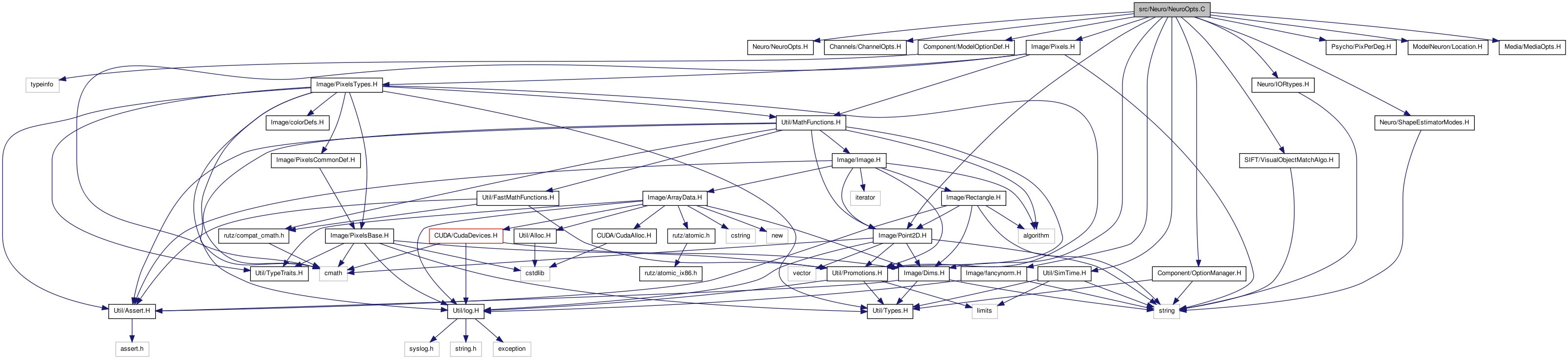
Go to the source code of this file.
Functions | |
| void | REQUEST_OPTIONALIAS_NEURO (OptionManager &m) |
| request all of the above-named OPT_ALIAS options | |
Variables | |
| const ModelOptionCateg | MOC_DISPLAY |
| What to display/save options. | |
| const ModelOptionCateg | MOC_PFC |
| Command-line options for Retina. | |
| const ModelOptionDef | OPT_PrefrontalCortexType |
| const ModelOptionCateg | MOC_RETINA |
| Retina-related options. | |
| const ModelOptionDef | OPT_RetinaType |
| const ModelOptionDef | OPT_InputFramingImageName |
| const ModelOptionDef | OPT_InputFramingImagePos |
| const ModelOptionDef | OPT_FoveateInputDepth |
| const ModelOptionDef | OPT_ShiftInputToEye |
| const ModelOptionDef | OPT_ShiftInputToEyeBGcol |
| const ModelOptionDef | OPT_InputFOV |
| const ModelOptionDef | OPT_RetinaSaveInput |
| const ModelOptionDef | OPT_RetinaSaveOutput |
| const ModelOptionDef | OPT_RetinaStdSavePyramid |
| const ModelOptionDef | OPT_RetinaMaskFname |
| const ModelOptionDef | OPT_RetinaFlipHoriz |
| const ModelOptionDef | OPT_RetinaFlipVertic |
| const ModelOptionDef | OPT_VisualCortexType |
| Command-line options for VisualCortex and derivatives. | |
| const ModelOptionDef | OPT_VCEMeyeFnames |
| const ModelOptionDef | OPT_VCEMsigma |
| const ModelOptionDef | OPT_VCEMforgetFac |
| const ModelOptionDef | OPT_VCEMdelay |
| const ModelOptionDef | OPT_VCEMuseMax |
| const ModelOptionDef | OPT_VCEMsaccadeOnly |
| const ModelOptionDef | OPT_SimulationViewerType |
| Command-line options for SimulationViewer and derivatvies. | |
| const ModelOptionDef | OPT_SVfontSize |
| const ModelOptionDef | OPT_SVsaveTraj |
| const ModelOptionDef | OPT_SVsaveXcombo |
| const ModelOptionDef | OPT_SVsaveYcombo |
| const ModelOptionDef | OPT_SVsaveTRMXcombo |
| const ModelOptionDef | OPT_SVsaveTRMYcombo |
| const ModelOptionDef | OPT_SVsaveTRMmegaCombo |
| const ModelOptionDef | OPT_SVwarp3D |
| const ModelOptionDef | OPT_SVmegaCombo |
| const ModelOptionDef | OPT_SVmegaComboZoom |
| const ModelOptionDef | OPT_SVmegaComboTopCMapsOnly |
| const ModelOptionDef | OPT_SVcropFOA |
| const ModelOptionDef | OPT_SVdisplayMapFactor |
| const ModelOptionDef | OPT_SVdisplayMapType |
| const ModelOptionDef | OPT_SVxwindow |
| const ModelOptionDef | OPT_SVfoveateTraj |
| const ModelOptionDef | OPT_SVstatsFname |
| const ModelOptionDef | OPT_SVdisplayFOA |
| const ModelOptionDef | OPT_SVdisplayPatch |
| const ModelOptionDef | OPT_SVpatchSize |
| const ModelOptionDef | OPT_SVeraseMarker |
| const ModelOptionDef | OPT_SVdisplayFOAnum |
| const ModelOptionDef | OPT_SVdisplayFOALinks |
| const ModelOptionDef | OPT_SVdisplayEye |
| const ModelOptionDef | OPT_SVdisplayEyeLinks |
| const ModelOptionDef | OPT_SVdisplayHead |
| const ModelOptionDef | OPT_SVdisplayHeadLinks |
| const ModelOptionDef | OPT_SVdisplayAdditive |
| const ModelOptionDef | OPT_SVdisplayTime |
| const ModelOptionDef | OPT_SVdisplayHighlights |
| const ModelOptionDef | OPT_SVdisplaySMmodulate |
| const ModelOptionDef | OPT_SVdisplayBoring |
| const ModelOptionDef | OPT_SVuseLargerDrawings |
| const ModelOptionDef | OPT_SVdisplayInterp |
| const ModelOptionDef | OPT_SVCOMPsaveMask |
| const ModelOptionDef | OPT_SVCOMPsaveFoveatedImage |
| const ModelOptionDef | OPT_SVCOMPDistanceFactor |
| const ModelOptionDef | OPT_SVCOMPsaveEyeCombo |
| const ModelOptionDef | OPT_SVCOMPnumFoveas |
| const ModelOptionDef | OPT_SVCOMPeyeCompare |
| const ModelOptionDef | OPT_SVCOMPcacheSize |
| const ModelOptionDef | OPT_SVCOMPiframePeriod |
| const ModelOptionDef | OPT_SVCOMPdisplayHumanEye |
| const ModelOptionDef | OPT_SVCOMPuseTRMmax |
| const ModelOptionDef | OPT_SVCOMPfoveaSCtype |
| const ModelOptionDef | OPT_SVCOMPMultiRetinaDepth |
| const ModelOptionDef | OPT_SVEMsaveMegaCombo |
| const ModelOptionDef | OPT_SVEMdelayCacheSize |
| const ModelOptionDef | OPT_SVEMmaxCacheSize |
| const ModelOptionDef | OPT_SVEMoutFname |
| const ModelOptionDef | OPT_SVEMsampleAtStart |
| const ModelOptionDef | OPT_SVEMdisplaySacNum |
| const ModelOptionDef | OPT_SVEMnumRandomSamples |
| const ModelOptionDef | OPT_SVEMuseSaccadeInBlink |
| const ModelOptionDef | OPT_SVEMuseDiagColors |
| const ModelOptionDef | OPT_SVEMlabelEyePatch |
| const ModelOptionDef | OPT_SVEMpriorRandomDistro |
| const ModelOptionDef | OPT_SVEMwriteFrameNumber |
| const ModelOptionDef | OPT_SVEMmaxComboWidth |
| const ModelOptionDef | OPT_SVEMbufDims |
| const ModelOptionDef | OPT_SVEMuseIOR |
| const ModelOptionDef | OPT_SVHandSaveCombo |
| const ModelOptionDef | OPT_SVHandMaxComboWidth |
| const ModelOptionDef | OPT_SVHandDisplay |
| const ModelOptionDef | OPT_SVeyeSimFname |
| const ModelOptionDef | OPT_SVeyeSimPeriod |
| const ModelOptionDef | OPT_SVeyeSimTrash |
| const ModelOptionDef | OPT_SVEMNprobeLocation |
| const ModelOptionDef | OPT_SVEMNrfSize |
| const ModelOptionDef | OPT_SVEMNrfMaskName |
| const ModelOptionDef | OPT_SVEMNoutFName |
| const ModelOptionDef | OPT_SVEMNneuroFileName |
| const ModelOptionDef | OPT_SVEMNdisplayTime |
| const ModelOptionDef | OPT_SVEMNdelayNeuron |
| const ModelOptionDef | OPT_SVEMNplotBufLength |
| const ModelOptionDef | OPT_SVEMNSalScale |
| const ModelOptionDef | OPT_SVEMNNeuroScale |
| const ModelOptionDef | OPT_SVEMNNeuroRFVisFile |
| const ModelOptionDef | OPT_SVEMNNeuroRFMotFile |
| const ModelOptionDef | OPT_SVEMNMotWindow |
| const ModelOptionDef | OPT_SVEMNVisWindow |
| const ModelOptionDef | OPT_SVEMNVisOffset |
| const ModelOptionDef | OPT_ASACdrawDiffParts |
| const ModelOptionDef | OPT_ASACdrawBetaParts |
| const ModelOptionDef | OPT_ASACdrawBiasParts |
| const ModelOptionDef | OPT_ASACdrawSeperableParts |
| const ModelOptionDef | OPT_ASACconfigFile |
| const ModelOptionDef | OPT_NerdCamConfigFile |
| const ModelOptionDef | OPT_FOAradius |
| const ModelOptionDef | OPT_SVInverseTransform |
| const ModelOptionDef | OPT_FoveaRadius |
| const ModelOptionDef | OPT_AGStatsSaveFile |
| const ModelOptionDef | OPT_ComputeAGStats |
| const ModelOptionCateg | MOC_ITC |
| Command-line options for InferoTemporal. | |
| const ModelOptionDef | OPT_InferoTemporalType |
| const ModelOptionDef | OPT_AttentionObjRecog |
| const ModelOptionDef | OPT_ObjectDatabaseFileName |
| const ModelOptionDef | OPT_TrainObjectDB |
| const ModelOptionDef | OPT_PromptUserTrainDB |
| const ModelOptionDef | OPT_MatchObjects |
| const ModelOptionDef | OPT_MatchingAlgorithm |
| const ModelOptionDef | OPT_RecognitionMinMatch |
| const ModelOptionDef | OPT_RecognitionMinMatchPercent |
| const ModelOptionDef | OPT_SortObjects |
| const ModelOptionDef | OPT_SortObjectsBy |
| const ModelOptionDef | OPT_SortKeys |
| const ModelOptionDef | OPT_OutputFileName |
| const ModelOptionDef | OPT_ShapeEstimatorMode |
| Command-line options for ShapeEstimator. | |
| const ModelOptionDef | OPT_ShapeEstimatorSmoothMethod |
| const ModelOptionCateg | MOC_BRAIN |
| Command-line options for Brain. | |
| const ModelOptionDef | OPT_BrainBoringDelay |
| const ModelOptionDef | OPT_BrainBoringSMmv |
| const ModelOptionDef | OPT_IORtype |
| const ModelOptionDef | OPT_BrainSaveObjMask |
| const ModelOptionDef | OPT_BlankBlink |
| const ModelOptionDef | OPT_BrainTooManyShifts |
| const ModelOptionDef | OPT_BrainTooManyShiftsPerFrame |
| const ModelOptionDef | OPT_TargetMaskFname |
| const ModelOptionCateg | MOC_SM |
| Command-line options for SaliencyMap. | |
| const ModelOptionDef | OPT_SaliencyMapType |
| const ModelOptionDef | OPT_SMsaveResults |
| const ModelOptionDef | OPT_SMsaveCumResults |
| const ModelOptionDef | OPT_SMuseSacSuppress |
| const ModelOptionDef | OPT_SMuseBlinkSuppress |
| const ModelOptionDef | OPT_SMfastInputCoeff |
| const ModelOptionDef | OPT_SMItoVcoeff |
| const ModelOptionDef | OPT_SMginhDecay |
| const ModelOptionDef | OPT_SMmaxWinV |
| const ModelOptionCateg | MOC_TRM |
| Command-line options for TaskRelevanceMap. | |
| const ModelOptionDef | OPT_TaskRelevanceMapType |
| const ModelOptionDef | OPT_TRMsaveResults |
| const ModelOptionDef | OPT_LearnTRM |
| const ModelOptionDef | OPT_LearnUpdateTRM |
| const ModelOptionDef | OPT_BiasTRM |
| const ModelOptionDef | OPT_TRMKillStaticThresh |
| const ModelOptionDef | OPT_TRMKillStaticCoeff |
| const ModelOptionDef | OPT_TRMkillN |
| const ModelOptionDef | OPT_TRMClusterCenterFile |
| const ModelOptionDef | OPT_TRMTemplateDir |
| const ModelOptionDef | OPT_TRMGistPCADims |
| const ModelOptionDef | OPT_TRMGistPCAMatrix |
| const ModelOptionDef | OPT_TRMCacheSize |
| const ModelOptionDef | OPT_TRMUpdatePeriod |
| const ModelOptionDef | OPT_TRMTigsMatrix |
| const ModelOptionDef | OPT_TRMImgPCADims |
| const ModelOptionDef | OPT_TRMImgPCAMatrix |
| const ModelOptionDef | OPT_TRMTigs2Matrix |
| const ModelOptionDef | OPT_TRMSocialRegionFName |
| const ModelOptionCateg | MOC_AGM |
| Command-line options for AttentionGuidanceMap. | |
| const ModelOptionDef | OPT_AttentionGuidanceMapType |
| const ModelOptionDef | OPT_AGMsaveResults |
| const ModelOptionDef | OPT_AGMoutputRate |
| used by AttentionGuidanceMapSC and AttentionGuidanceMapNF | |
| const ModelOptionCateg | MOC_AG |
| AttentionGate options. | |
| const ModelOptionDef | OPT_AttentionGateType |
| const ModelOptionDef | OPT_AttentionGateStageOneType |
| const ModelOptionDef | OPT_AttentionGateStageTwoType |
| const ModelOptionDef | OPT_AttentionGateStageTwoEpochs |
| const ModelOptionDef | OPT_AGsaveResults |
| const ModelOptionDef | OPT_AGTargetFrame |
| const ModelOptionDef | OPT_AGMaskFile |
| const ModelOptionCateg | MOC_WTA |
| Command-line options for WinnerTakeAll. | |
| const ModelOptionDef | OPT_WinnerTakeAllType |
| const ModelOptionDef | OPT_WTAsaveResults |
| const ModelOptionDef | OPT_WTAuseSacSuppress |
| const ModelOptionDef | OPT_WTAuseBlinkSuppress |
| const ModelOptionDef | OPT_WinnerTakeAllGreedyThreshFac |
| const ModelOptionCateg | MOC_SAC |
| Command-line options for SaccadeController and derivatives. | |
| const ModelOptionDef | OPT_SCeyeInitialPosition |
| const ModelOptionDef | OPT_SCheadInitialPosition |
| const ModelOptionDef | OPT_SCeyeMinSacLen |
| const ModelOptionDef | OPT_SCheadMinSacLen |
| const ModelOptionDef | OPT_SCeyeSpringK |
| const ModelOptionDef | OPT_SCeyeFrictionMu |
| const ModelOptionDef | OPT_SCeyeThreshMinOvert |
| const ModelOptionDef | OPT_SCeyeThreshMaxCovert |
| const ModelOptionDef | OPT_SCeyeThreshMinNum |
| const ModelOptionDef | OPT_SCeyeThreshSalWeigh |
| const ModelOptionDef | OPT_SCeyeMaxIdleSecs |
| const ModelOptionDef | OPT_SCheadSpringK |
| const ModelOptionDef | OPT_SCheadFrictionMu |
| const ModelOptionDef | OPT_SCheadThreshMinOvert |
| const ModelOptionDef | OPT_SCheadThreshMaxCovert |
| const ModelOptionDef | OPT_SCheadThreshMinNum |
| const ModelOptionDef | OPT_SCheadThreshSalWeigh |
| const ModelOptionDef | OPT_SCheadMaxIdleSecs |
| const ModelOptionDef | OPT_SCeyeBlinkWaitTime |
| const ModelOptionDef | OPT_SCeyeBlinkDuration |
| const ModelOptionDef | OPT_EHCeyeTrackConfig |
| const ModelOptionDef | OPT_EyeHeadControllerType |
| const ModelOptionDef | OPT_SaccadeControllerEyeType |
| const ModelOptionDef | OPT_SaccadeControllerHeadType |
| const ModelOptionCateg | MOC_HAND |
| HandController-related options. | |
| const ModelOptionDef | OPT_HandControllerType |
| const ModelOptionDef | OPT_HandConfig |
| const ModelOptionCateg | MOC_GE |
| Command-line options for GistEstimator. | |
| const ModelOptionDef | OPT_GistEstimatorType |
| const ModelOptionDef | OPT_GistCenterSurroundFlag |
| const ModelOptionDef | OPT_SaveGistFlag |
| const ModelOptionCateg | MOC_VB |
| Command-line options for VisualBuffer. | |
| const ModelOptionDef | OPT_VisualBufferType |
| const ModelOptionDef | OPT_VBignoreBoring |
| const ModelOptionDef | OPT_VBobjectBased |
| const ModelOptionDef | OPT_VBdims |
| const ModelOptionDef | OPT_VBtimePeriod |
| const ModelOptionDef | OPT_VBdecayFactor |
| const ModelOptionDef | OPT_VBmaxNormType |
| const ModelOptionDef | OPT_PixelsPerDegree |
| const ModelOptionDef | OPT_HeadMarkerRadius |
| Miscellaneous shared command-line options for neuro classes. | |
| const ModelOptionDef | OPT_MultiRetinaDepth |
| const ModelOptionDef | OPT_ALIASinitialVCO |
| const ModelOptionDef | OPT_ALIAStop5 |
| Neuro-related command-line option aliases. | |
| const ModelOptionDef | OPT_ALIASmovie |
| const ModelOptionDef | OPT_ALIASmovieFast |
| const ModelOptionDef | OPT_ALIASmoviefov |
| const ModelOptionDef | OPT_ALIASmovieeyehead |
| const ModelOptionDef | OPT_ALIASmovieanim |
| const ModelOptionDef | OPT_ALIASsurprise |
| const ModelOptionDef | OPT_ALIASsurpriseRSVP |
| Current optimal settings for RSVP sequences. | |
| const ModelOptionDef | OPT_ALIASeyeCompare |
| const ModelOptionDef | OPT_ALIASeyeDisplay |
| const ModelOptionDef | OPT_ALIASeyeMap |
| const ModelOptionDef | OPT_ALIASeyeHandDisplay |
| const ModelOptionDef | OPT_ALIASbestMultiSpectralResidual |
| const ModelOptionDef | OPT_ALIASoptiGainTrain |
| const ModelOptionDef | OPT_ALIASoptiGainBias |
| const ModelOptionDef | OPT_ALIASkinectDemo |
Definition in file NeuroOpts.C.
| void REQUEST_OPTIONALIAS_NEURO | ( | OptionManager & | m | ) |
request all of the above-named OPT_ALIAS options
Definition at line 2033 of file NeuroOpts.C.
References REQUEST_OPTIONALIAS_CHANNEL(), and OptionManager::requestOptionAlias().
Referenced by main().
| const ModelOptionCateg MOC_AG |
 {
  MOC_SORTPRI_3, "Attention Gate Related Options" }
AttentionGate options.
Definition at line 1426 of file NeuroOpts.C.
| const ModelOptionCateg MOC_AGM |
 {
  MOC_SORTPRI_3, "Attention Guidance Map Related Options" }
Command-line options for AttentionGuidanceMap.
AttentionGuidanceMap options
Definition at line 1396 of file NeuroOpts.C.
| const ModelOptionCateg MOC_BRAIN |
 {
  MOC_SORTPRI_3, "General Brain/Attention-Related Options" }
Command-line options for Brain.
Brain-related options
Definition at line 1093 of file NeuroOpts.C.
| const ModelOptionCateg MOC_DISPLAY |
 {
  MOC_SORTPRI_2, "What to Display/Save Options" }
What to display/save options.
Definition at line 58 of file NeuroOpts.C.
| const ModelOptionCateg MOC_GE |
 {
  MOC_SORTPRI_3, "Gist Estimator Options" }
Command-line options for GistEstimator.
GistEstimator Options
Definition at line 1708 of file NeuroOpts.C.
| const ModelOptionCateg MOC_HAND |
 {
  MOC_SORTPRI_3, "Hand Controller Options" }
HandController-related options.
Definition at line 1684 of file NeuroOpts.C.
| const ModelOptionCateg MOC_ITC |
 {
  MOC_SORTPRI_3, "Inferior Temporal Cortex Options" }
Command-line options for InferoTemporal.
Inferior Temporal Cortex Options
Definition at line 962 of file NeuroOpts.C.
| const ModelOptionCateg MOC_PFC |
 {
  MOC_SORTPRI_3,   "PrefrontalCortex-Related Options" }
Command-line options for Retina.
PFC-related options
Definition at line 81 of file NeuroOpts.C.
| const ModelOptionCateg MOC_RETINA |
 {
  MOC_SORTPRI_3,   "Retina-Related Options" }
Retina-related options.
Definition at line 94 of file NeuroOpts.C.
| const ModelOptionCateg MOC_SAC |
 {
  MOC_SORTPRI_3, "Eye/Head Saccade Controller Options" }
Command-line options for SaccadeController and derivatives.
SaccadeController-related options
Definition at line 1522 of file NeuroOpts.C.
| const ModelOptionCateg MOC_SM |
 {
  MOC_SORTPRI_3, "Saliency Map Related Options" }
Command-line options for SaliencyMap.
SaliencyMap options
Definition at line 1156 of file NeuroOpts.C.
| const ModelOptionCateg MOC_TRM |
 {
  MOC_SORTPRI_3, "Task-Relevance Map Related Options" }
Command-line options for TaskRelevanceMap.
TaskRelevanceMap options
Definition at line 1235 of file NeuroOpts.C.
| const ModelOptionCateg MOC_VB |
 {
  MOC_SORTPRI_3, "Visual Buffer Related Options" }
Command-line options for VisualBuffer.
VisualBuffer options
Definition at line 1736 of file NeuroOpts.C.
| const ModelOptionCateg MOC_WTA |
 {
  MOC_SORTPRI_3, "Winner-Take-All Related Options" }
Command-line options for WinnerTakeAll.
WinnerTakeAll options
Definition at line 1479 of file NeuroOpts.C.
| const ModelOptionDef OPT_AGMaskFile |
  { MODOPT_ARG_STRING, "AGMaskFile", &MOC_AG, OPTEXP_CORE,
    "Name of the ground truth mask file to use if any. "
    "Should be a file name string",
    "ag-maskfile", '\0', "<string>", "mask.png" }
Definition at line 1471 of file NeuroOpts.C.
  { MODOPT_ARG(SimTime), "AGMoutputRate", &MOC_AGM, OPTEXP_SAVE,
    "the rate at which we post our output maps",
    "agm-output-rate", '\0', "<SimTime>", "10ms" }
used by AttentionGuidanceMapSC and AttentionGuidanceMapNF
Definition at line 1419 of file NeuroOpts.C.
| const ModelOptionDef OPT_AGMsaveResults |
  { MODOPT_FLAG, "AGMsaveResults", &MOC_AGM, OPTEXP_SAVE,
    "Save attention guidance map",
    "save-agm", '\0', "", "false" }
Definition at line 1412 of file NeuroOpts.C.
| const ModelOptionDef OPT_AGsaveResults |
  { MODOPT_FLAG, "AGsaveResults", &MOC_AG, OPTEXP_SAVE,
    "Save attention gate maps",
    "save-ag", '\0', "", "false" }
Definition at line 1458 of file NeuroOpts.C.
| const ModelOptionDef OPT_AGStatsSaveFile |
{ MODOPT_ARG_STRING, "AGStatsSaveFile", &MOC_DISPLAY, OPTEXP_CORE,
    "Prefix for saving attention gate stats",
    "ag-statsfile", '\0', "<file>", "ag-stats"}
Definition at line 949 of file NeuroOpts.C.
| const ModelOptionDef OPT_AGTargetFrame |
  { MODOPT_ARG(int), "AGTargetFrame", &MOC_AG, OPTEXP_CORE,
    "Which frame contains the target if needed "
    "An integer such as 11.",
    "ag-tframe", '\0', "<int>", "0" }
Definition at line 1464 of file NeuroOpts.C.
| const ModelOptionDef OPT_ALIASbestMultiSpectralResidual |
  { MODOPT_ALIAS, "ALIASbestMultiSpectralResidual", &MOC_CHANNEL, OPTEXP_CORE,
    "Use a tuned multi-spectral residual model",
    "best-multi-srs", '\0', "",
    "--vc-type=MultiSpectralResidual --maxnorm-type=Ignore "
    "--noenable-pyramid-caches --multi-srs-sizes=/16,/8,/4,/2 "
    "--srs-output-blur-factor=0.055 --srs-spectral-blur=1 "
    "--srs-attenuation-width=0.0625 --map-combine-type=Max "
    "--srs-lowpass-filter-width=2 " }
Definition at line 1986 of file NeuroOpts.C.
| const ModelOptionDef OPT_ALIASeyeCompare |
  { MODOPT_ALIAS, "ALIASeyeCompare", &MOC_ALIAS, OPTEXP_CORE,
    "Use standard mode for comparison between the model's output and "
    "a human or monkey (or other) eye movement trace. Do not forget to set "
    "at least the following depending on your specific experiment and data:\n"
    "  --foa-radius=<radius>        depending on size of display;\n"
    "  --eyetrack-data=<file, ...>  your .eyeS eye movement record file(s);\n"
    "  --svem-out-fname=<file>      where the results will be saved;\n"
    "  --svem-prior-distro=<file>   for non-uniform random sampling. \n"
    "And very carefully check for other settings as well",
    "eyecompare", '\0', "",
    "--sv-type=EyeMvt --save-eyemvt-megacombo "
    "--wta-type=Std --ior-type=None --shape-estim-mode=None "
    "--maxcache-size=0 --nowta-sacsupp --nowta-blinksupp "
    "--nosalmap-sacsupp --nosalmap-blinksupp" }
Definition at line 1922 of file NeuroOpts.C.
| const ModelOptionDef OPT_ALIASeyeDisplay |
  { MODOPT_ALIAS, "ALIASeyeDisplay", &MOC_ALIAS, OPTEXP_CORE,
    "Display one or more eye-tracking traces on top of a movie. This should "
    "be used with the following options:\n"
    "  --foa-radius=<radius>        depending on size of display;\n"
    "  --eyetrack-data=<file, ...>  your .eyeS eye movement record file(s);\n"
    "And very carefully check for other settings as well",
    "eyedisplay", '\0', "",
    "--sv-type=EyeMvt -T --vc-type=None --sm-type=None --trm-type=None "
    "--wta-type=None --shape-estim-mode=None --fovea-radius=32 "
    "--maxcache-size=0 --delaycache-size=0" }
Definition at line 1939 of file NeuroOpts.C.
| const ModelOptionDef OPT_ALIASeyeHandDisplay |
  { MODOPT_ALIAS, "ALIASeyeHandDisplay", &MOC_ALIAS, OPTEXP_CORE,
    "Display one or more eye-tracking and hand movement traces on top of "
    "a movie. This should be used with the following options:\n"
    "  --foa-radius=<radius>        depending on size of display;\n"
    "  --eyetrack-data=<file, ...>  your .eyeS eye movement record file(s);\n"
    "  --handtrack-data=<file, ...> your .hanD hand movement record file(s);\n"
    "And very carefully check for other settings as well",
    "eyehand-display", '\0', "",
    "--sv-type=EyeHand -T --vc-type=None --sm-type=None --trm-type=None "
    "--wta-type=None --shape-estim-mode=None --fovea-radius=32 "
    "--maxcache-size=0 --delaycache-size=0" }
Definition at line 1972 of file NeuroOpts.C.
| const ModelOptionDef OPT_ALIASeyeMap |
  { MODOPT_ALIAS, "ALIASeyeMap", &MOC_ALIAS, OPTEXP_CORE,
    "Build a cumulative eye movement density map from one or more eye "
    "movement traces. This is useful if you have one or more observers that "
    "saw a same stimulus and you want to build a spatial probability density "
    "function from the eye traces. The resulting eye map can be compared, "
    "for example, with saliency maps or can be sampled in specific target "
    "regions. This should be used used with the following options:\n"

    "  --in=<image>                  input image, for dims only;\n"
    "  --vcem-eyefnames=<file, ...>  your .eyeS eye movement record file(s);\n"
    "  --output-frames=0-0@XXms      set XX to the time when to save;\n"
    "And very carefully check for other settings as well",
    "eyemap", '\0', "",
    "--nouse-fpe --nouse-random --save-vcx-output --out=raster: -+ "
    "--vc-type=EyeMvt --sm-type=None --trm-type=None --wta-type=None "
    "--shape-estim-mode=None --sv-type=None --vcem-forgetfac=1.0 "
    "--vcem-delay=0 --vcem-sigma=0 --vcem-saconly=true --vcem-usemax=true "
    "--output-format=PFM" }
Definition at line 1952 of file NeuroOpts.C.
| const ModelOptionDef OPT_ALIASinitialVCO |
  { MODOPT_ALIAS, "ALIASinitialVCO", &MOC_ALIAS, OPTEXP_CORE,
    "Just save the initial saliency map (i.e., output from the VisualCortex) "
    "before any shift of attention, and exit. The floating-point map will "
    "be saved in our proprietary PFM image format and with prefix 'VCO', "
    "which is harder to visualize but good for comparisons across images "
    "as it contains absolute saliency values. See saliency/matlab/"
    "pfmreadmatlab.m for a simple function to read a PFM image into Matlab. "
    "Note that the values in the map are typically very small, as they "
    "are in Amperes of synaptic current flowing into the integrate-and-fire "
    "neurons of the dynamic saliency map. Typical values are in the nA "
    "range (1.0e-9 Amps). You can also use saliency/bin/pfmtopgm to convert "
    "the map to a PGM image.",
    "just-initial-saliency-map", '\0', "",
    "--nouse-fpe --nouse-random --save-vcx-output --out=raster: "
    "--out=pfm: --too-much-time=0.1ms --output-frames=0-0@0.1ms " }
Definition at line 1812 of file NeuroOpts.C.
| const ModelOptionDef OPT_ALIASkinectDemo |
  { MODOPT_ALIAS, "ALIASkinectDemo", &MOC_ALIAS, OPTEXP_CORE,
    "Demonstrate the Kinect sensor by computing saliency over a combination of RGB and Depth images.",
    "kinect-demo", '\0', "",
    "-K --in=kinect --out=display --maxnorm-type=Maxnorm --retina-type=Stub --nodisplay-interp-maps "
    "--ior-type=None --vc-type=Thread:Std -j 6 --vc-chans=YCIOFM"
  }
Definition at line 2025 of file NeuroOpts.C.
| const ModelOptionDef OPT_ALIASmovie |
  { MODOPT_ALIAS, "ALIASmovie", &MOC_ALIAS, OPTEXP_CORE,
    "Process in movie (multiframe) mode",
    "movie", '\0', "",
    "--nodisplay-traj --nodisplay-additive --nouse-fpe "
    "--display-map-factor=50000 --display-map=AGM "
    "--nouse-random --nodisplay-foa --display-patch" }
Definition at line 1842 of file NeuroOpts.C.
| const ModelOptionDef OPT_ALIASmovieanim |
  { MODOPT_ALIAS, "ALIASmovieanim", &MOC_ALIAS, OPTEXP_CORE,
    "Process in foveated movie (multiframe) mode with a human-derived "
    "ModelW Eye/Head SaccadeController, a WinnerTakeAllGreedy, no IOR, "
    "and displays of head position",
    "movieanim", '\0', "",
    "--movie --foveate-input-depth=4 --sc-type=ModelW "
    "--ior-type=None --display-head --shape-estim-mode=None "
    "--wta-type=Greedy --initial-eyepos=-2,-2 --initial-headpos=-2,-2" }
Definition at line 1883 of file NeuroOpts.C.
| const ModelOptionDef OPT_ALIASmovieeyehead |
  { MODOPT_ALIAS, "ALIASmovieeyehead", &MOC_ALIAS, OPTEXP_CORE,
    "Process in foveated movie (multiframe) mode with a Monkey2 "
    "Eye/Head SaccadeController and displays of head position",
    "movieeyehead", '\0', "",
    "--moviefov --sc-type=Monkey2 --display-head" }
Definition at line 1875 of file NeuroOpts.C.
| const ModelOptionDef OPT_ALIASmovieFast |
  { MODOPT_ALIAS, "ALIASmovieFast", &MOC_ALIAS, OPTEXP_CORE,
    "Process in movie (multiframe) mode, making some approximations in the "
    "computations to make processing fast albeit slightly different from the "
    "gold standard. You still need to provide:\n"
    "   --in=<movie>    input movie\n"
    "   --out=display   or any other output\n"
    "   -j <n>          for the number of parallel threads (default 4)\n"
    "   -T              or similar option (like -X, -Y, -K) for what to display.",
    "moviefast", '\0', "",
    "--movie --display-foa --sm-type=Fast --wta-type=Fast --nodisplay-interp-maps "
    "--ior-type=None --vc-type=Thread:Std --vc-chans=CIOFM -j 4 --timestep=30ms --maxnorm-type=FancyWeak "
    "--input-frames=0-MAX@30ms --output-frames=0-MAX@30ms --logverb=Error" }
Definition at line 1851 of file NeuroOpts.C.
| const ModelOptionDef OPT_ALIASmoviefov |
  { MODOPT_ALIAS, "ALIASmoviefov", &MOC_ALIAS, OPTEXP_CORE,
    "Process in foveated movie (multiframe) mode with a ThreshFric "
    "SaccadeController",
    "moviefov", '\0', "",
    "--movie --foveate-input-depth=6 --ehc-type=Simple "
    "--esc-type=Threshfric --ior-type=None --trm-type=KillStatic" }
Definition at line 1866 of file NeuroOpts.C.
| const ModelOptionDef OPT_ALIASoptiGainBias |
  { MODOPT_ALIAS, "ALIASoptiGainBias", &MOC_ALIAS, OPTEXP_CORE,
    "Use a set of gains to bias salience computation in a manner similar "
    "to Jeremy Wolfe's Guided Search (Wolfe, 1994). The gains are read "
    "from a ParamMap file which can be obtained, for example, by using "
    "--train-optigains. You will need to set the following:\n"
    "  --in=image.png              input image to process;\n"
    "  --gains-filename=file.pmap  file to load the gains from",
    "guided-search", '\0', "",
    "--vc-type=Std --vc-chans=GNO --nouse-older-version -K --out=display --pfc-type=GS "
    "--num-colorband=6 --num-satband=6 --num-intensityband=6 --num-orient=8"
  }
Definition at line 2012 of file NeuroOpts.C.
| const ModelOptionDef OPT_ALIASoptiGainTrain |
  { MODOPT_ALIAS, "ALIASoptiGainTrain", &MOC_ALIAS, OPTEXP_CORE,
    "Extract salience information to train the optimal gain biasing model of "
    "Navalpakkam and Itti (IEEE-CVPR 2006; Neuron 2007). This will "
    "essentially select multi-band features and setup the training process. "
    "You will then also need to provide:\n"
    "  --in=xmlfile:file.xml   input image and region of interest metadata;\n"
    "  --stsd-filename=file.pmap  to save saliency of target/distractors;\n"
    "The resulting sT/sD pmap files can be combined together using "
    "app-combineOptimalGains to yield a gains file that can be used with "
    "the --guided-search option",
    "train-optigains", '\0', "",
    "--vc-type=Std --vc-chans=GNO --nouse-older-version --out=display --pfc-type=OG "
    "--num-colorband=6 --num-satband=6 --num-intensityband=6 --num-orient=8"
  }
Definition at line 1996 of file NeuroOpts.C.
| const ModelOptionDef OPT_ALIASsurprise |
  { MODOPT_ALIAS, "ALIASsurprise", &MOC_ALIAS, OPTEXP_CORE,
    "Use standard surprise mode",
    "surprise", '\0', "",
    "--vc-type=Surp --vc-chans=CFIOM --maxnorm-type=Surprise "
    "--gabor-intens=20.0 --direction-sqrt "
    "--display-map=VCO --display-map-factor=1e11 "
    "--vcx-outfac=5.0e-9" }
Definition at line 1894 of file NeuroOpts.C.
  { MODOPT_ALIAS, "ALIASsurpriseRSVP", &MOC_ALIAS, OPTEXP_CORE,
    "Use RSVP optimized surprise mode",
    "surpriseRSVP", '\0', "",
    "--vc-type=Surp --vc-chans=I:0.312778365O:1.566049997H:0.877309234 --maxnorm-type=Surprise "
    "--gabor-intens=20.0 --direction-sqrt "
    "--display-map=VCO --display-map-factor=1e11 "
    "--vcx-outfac=5.0e-9"
    "--ior-type=None --nouse-random --display-foa"
    "--sm-type=Trivial --wta-type=None"
    "--salmap-factor=1e12 --agm-factor=1e12" }
Current optimal settings for RSVP sequences.
See matlab/linear-classifier/linear_model.m Error = 0.2179999999999999993338661852249060757458209991455078125000000000 X = [ 0.8773092344262305442015303924563340842723846435546875000000000000 ... 0.3127783654225734788489887705509318038821220397949218750000000000 ... 1.5660499968021082128899479357642121613025665283203125000000000000 ];
Definition at line 1910 of file NeuroOpts.C.
| const ModelOptionDef OPT_ALIAStop5 |
  { MODOPT_ALIAS, "ALIAStop5", &MOC_ALIAS, OPTEXP_CORE,
    "Compute the saliency map and save the first five attended locations. "
    "This will save five images, T000000.pnm to T000004.pnm which show the "
    "trajectory taken by the first five shifts of the focus of attention, "
    "as well as a text file 'top5.txt' with the coordinates of the attended "
    "locations as well as other information.",
    "top5", '\0', "",
    "--nouse-fpe --nouse-random -T --textlog=top5.txt --too-many-shifts=5 "
    "--output-frames=0-4@EVENT --out=raster: -+" }
Neuro-related command-line option aliases.
Definition at line 1830 of file NeuroOpts.C.
| const ModelOptionDef OPT_ASACconfigFile |
{ MODOPT_ARG_STRING, "ASACconfigFile", &MOC_DISPLAY, OPTEXP_CORE,
    "What config file to load with Surprise Control",
    "ASAC-config-file", '\0', "<file>",
    "/lab/mundhenk/saliency/etc/surpriseControl.conf"}
Definition at line 916 of file NeuroOpts.C.
| const ModelOptionDef OPT_ASACdrawBetaParts |
  { MODOPT_FLAG, "ASACdrawBetaParts", &MOC_DISPLAY, OPTEXP_CORE,
    "Cause Surprise Control to draw beta images",
    "ASAC-draw-beta-parts", '\0', "", "false" }
Definition at line 898 of file NeuroOpts.C.
| const ModelOptionDef OPT_ASACdrawBiasParts |
  { MODOPT_FLAG, "ASACdrawBiasParts", &MOC_DISPLAY, OPTEXP_CORE,
    "Cause Surprise Control to draw bias images",
    "ASAC-draw-bias-parts", '\0', "", "false" }
Definition at line 904 of file NeuroOpts.C.
| const ModelOptionDef OPT_ASACdrawDiffParts |
  { MODOPT_FLAG, "ASACdrawDiffParts", &MOC_DISPLAY, OPTEXP_CORE,
    "Cause Surprise Control to draw difference images",
    "ASAC-draw-diff-parts", '\0', "", "false" }
Definition at line 892 of file NeuroOpts.C.
| const ModelOptionDef OPT_ASACdrawSeperableParts |
  { MODOPT_FLAG, "ASACdrawSeperableParts", &MOC_DISPLAY, OPTEXP_CORE,
    "Cause Surprise Control to draw layers of seperable filter images",
    "ASAC-draw-seperable-parts", '\0', "", "false" }
Definition at line 910 of file NeuroOpts.C.
| const ModelOptionDef OPT_AttentionGateStageOneType |
  { MODOPT_ARG_STRING, "AttentionGateStageOneType", &MOC_AG, OPTEXP_CORE,
    "Type of stage one Attention Gate to use. "
    "Simple or Complex",
    "ag-so-type", '\0', "<Simple|Complex>", "Simple" }
Definition at line 1437 of file NeuroOpts.C.
| const ModelOptionDef OPT_AttentionGateStageTwoEpochs |
  { MODOPT_ARG(int), "AttentionGateStageTwoEpochs", &MOC_AG, OPTEXP_CORE,
    "How many epochs to look forward and backwards. "
    "An integer such as 5.",
    "ag-st-epochs", '\0', "<int>", "5" }
Definition at line 1451 of file NeuroOpts.C.
| const ModelOptionDef OPT_AttentionGateStageTwoType |
  { MODOPT_ARG_STRING, "AttentionGateStageTwoType", &MOC_AG, OPTEXP_CORE,
    "Type of stage two Attention Gate to use. "
    "Std or None",
    "ag-st-type", '\0', "<Std|None>", "None" }
Definition at line 1444 of file NeuroOpts.C.
| const ModelOptionDef OPT_AttentionGateType |
  { MODOPT_ARG_STRING, "AttentionGateType", &MOC_AG, OPTEXP_CORE,
    "Type of Attention Gate to use. "
    "Std or None",
    "ag-type", '\0', "<Std|None>", "None" }
Definition at line 1430 of file NeuroOpts.C.
| const ModelOptionDef OPT_AttentionGuidanceMapType |
  { MODOPT_ARG_STRING, "AttentionGuidanceMapType", &MOC_AGM, OPTEXP_CORE,
    "Type of Attention Guidance Map to use. 'None' for no map (in which "
    "case Brain will use the bottom-up saliency map for attention "
    "guidance), 'Std' for the standard AGM that just computes the pointwise "
    "product between bottom-up saliency map and top-down task-relevance "
    "map.  'NF' for maps based on simple neural fields. 'SC' for an AGM "
    "based on the neural architecture and "
    "functionality of the superior colliculus.",
    "agm-type", '\0', "<None|Std|Opt|NF|SC>", "Std" }
Definition at line 1400 of file NeuroOpts.C.
| const ModelOptionDef OPT_AttentionObjRecog |
  { MODOPT_FLAG, "ITCAttentionObjRecog", &MOC_ITC, OPTEXP_CORE,
    "Use ShapeEstimator to create a mask around the attended object prior "
    "to recognition.",
    "it-use-se", '\0', "", "no" }
Definition at line 973 of file NeuroOpts.C.
| const ModelOptionDef OPT_BiasTRM |
  { MODOPT_ARG_STRING, "BiasTRM", &MOC_TRM, OPTEXP_CORE,
    "bias the TRM with the given image", "bias-trm", '\0', "<file>", "" }
Definition at line 1270 of file NeuroOpts.C.
| const ModelOptionDef OPT_BlankBlink |
  { MODOPT_FLAG, "BlankBlink", &MOC_BRAIN, OPTEXP_CORE,
    "Blank-out visual input during eye blinks",
    "blank-blink", '\0', "", "false" }
Definition at line 1127 of file NeuroOpts.C.
| const ModelOptionDef OPT_BrainBoringDelay |
  { MODOPT_ARG(SimTime), "BrainBoringDelay", &MOC_BRAIN, OPTEXP_CORE,
    "Attention shifts that come after an interval longer than this "
    "will be considered 'boring' (for example, they may be represented "
    "differently in output displays)",
    "boring-delay", '\0', "<time>", "200.0ms" }
Definition at line 1097 of file NeuroOpts.C.
| const ModelOptionDef OPT_BrainBoringSMmv |
  { MODOPT_ARG(float), "BrainBoringSMmv", &MOC_SM, OPTEXP_CORE,
    "Saliency map level (in mV) below which attention shifts will be "
    "considered 'boring' (for example, they may be represented "
    "differently in output displays)",
    "boring-sm-mv", '\0', "<float>", "3.0" }
Definition at line 1105 of file NeuroOpts.C.
| const ModelOptionDef OPT_BrainSaveObjMask |
  { MODOPT_FLAG, "BrainSaveObjMask", &MOC_DISPLAY, OPTEXP_SAVE,
    "Save object mask",
    "save-objmask", '\0', "", "false" }
Definition at line 1121 of file NeuroOpts.C.
| const ModelOptionDef OPT_BrainTooManyShifts |
  { MODOPT_ARG(int), "BrainTooManyShifts", &MOC_BRAIN, OPTEXP_CORE,
    "Exit after this number of covert attention shifts",
    "too-many-shifts", '\0', "<int>", "0" }
Definition at line 1133 of file NeuroOpts.C.
| const ModelOptionDef OPT_BrainTooManyShiftsPerFrame |
  { MODOPT_ARG(int), "BrainTooManyShiftsPerFrame", &MOC_BRAIN, OPTEXP_CORE,
    "Wait untill the next frame after this number of covert attention shifts",
    "too-many-shifts-per-frame", '\0', "<int>", "0" }
Definition at line 1138 of file NeuroOpts.C.
| const ModelOptionDef OPT_ComputeAGStats |
  { MODOPT_FLAG, "ComputeAGStats", &MOC_DISPLAY, OPTEXP_CORE,
    "Should we compute the AG stats with ground truth?",
    "savestats-ag", '\0', "", "false" }
Definition at line 955 of file NeuroOpts.C.
| const ModelOptionDef OPT_EHCeyeTrackConfig |
  { MODOPT_ARG_STRING, "EHCeyeTrackConfig", &MOC_SAC, OPTEXP_CORE,
    "Config string to determine which eye-tracking files to use for "
    "comparison with model predictions. This should be a "
    "comma-separated list of eyetrace filenames.",
    "eyetrack-data", '\0',
    "<filename,filename,...>", "" }
Definition at line 1650 of file NeuroOpts.C.
| const ModelOptionDef OPT_EyeHeadControllerType |
  { MODOPT_ARG_STRING, "EyeHeadControllerType", &MOC_SAC, OPTEXP_CORE,
    "Eye/Head Controller name (pick a name and then use --help to see "
    "options specific to the chosen controller)",
    "ehc-type", '\0',
    "<None|Simple|EyeTrack|Monkey>", "None" }
Definition at line 1659 of file NeuroOpts.C.
| const ModelOptionDef OPT_FOAradius |
  { MODOPT_ARG(int), "FOAradius", &MOC_DISPLAY, OPTEXP_CORE,
    "Radius of the Focus Of Attention, or 0 to set it from input image dims",
    "foa-radius", '\0', "<pixels>", "0" }
Definition at line 931 of file NeuroOpts.C.
| const ModelOptionDef OPT_FoveaRadius |
  { MODOPT_ARG(int), "FoveaRadius", &MOC_DISPLAY, OPTEXP_CORE,
    "Radius of the fovea, or 0 to set it from input image dims",
    "fovea-radius", '\0', "<pixels>", "0" }
Definition at line 943 of file NeuroOpts.C.
| const ModelOptionDef OPT_FoveateInputDepth |
  { MODOPT_ARG(uint), "FoveateInputDepth", &MOC_RETINA, OPTEXP_CORE,
    "Depth of pyramid to use to foveate input frames",
    "foveate-input-depth", '\0', "<uint>", "0" }
Definition at line 122 of file NeuroOpts.C.
| const ModelOptionDef OPT_GistCenterSurroundFlag |
  { MODOPT_ARG(int), "GistEstimatorCenterSurroundFlag", &MOC_GE, OPTEXP_CORE,
    "use center surround to compute the gist or not"
    "0: no center-surround, 1: only use center-surround"
    "2: use both center-surround and non center-surround",
    "gist-cs", '\0',"<0|1|2>", "1" }
Definition at line 1719 of file NeuroOpts.C.
| const ModelOptionDef OPT_GistEstimatorType |
  { MODOPT_ARG_STRING, "GistEstimatorType", &MOC_GE, OPTEXP_CORE,
    "Type of gist estimator to use",
    "ge-type", '\0',
    "<None|Std|FFT|Texton|CB|BBoF|SurfPMK|Gen>", "None" }
Definition at line 1712 of file NeuroOpts.C.
| const ModelOptionDef OPT_HandConfig |
  { MODOPT_ARG_STRING, "HandConfig", &MOC_HAND, OPTEXP_CORE,
    "Config string to determine which hand-tracking files to use for "
    "comparison with model predictions. This should be a "
    "comma-separated list of handtrace filenames.",
    "handtrack-data", '\0',
    "<filename,filename,...>", "" }
Definition at line 1696 of file NeuroOpts.C.
| const ModelOptionDef OPT_HandControllerType |
  { MODOPT_ARG_STRING, "HandControllerType", &MOC_HAND, OPTEXP_CORE,
    "Hand Controller name (pick a name and then use --help to see "
    "options specific to the chosen controller)",
    "hand-type", '\0',
    "<None|HandTrack>", "None" }
Definition at line 1688 of file NeuroOpts.C.
  { MODOPT_ARG(int), "HeadMarkerRadius", &MOC_BRAIN, OPTEXP_CORE,
    "Radius of the head position marker",
    "head-radius", '\0', "<pixels>", "50" }
Miscellaneous shared command-line options for neuro classes.
Definition at line 1795 of file NeuroOpts.C.
| const ModelOptionDef OPT_InferoTemporalType |
  { MODOPT_ARG_STRING, "ITCInferoTemporalType", &MOC_ITC, OPTEXP_CORE,
    "Type of InferoTemporal to use. 'None','Std','SalBayes', 'HMAX' or 'CUDAHMAX'",
    "it-type", '\0', "<None|Std|SalBayes|HMAX|CUDAHMAX>", "None" }
Definition at line 966 of file NeuroOpts.C.
| const ModelOptionDef OPT_InputFOV |
  { MODOPT_ARG(Dims), "InputFOV", &MOC_RETINA, OPTEXP_CORE,
    "If non-empty, centrally crop the input images to the given "
    "field-of-view dimensions",
    "input-fov", '\0', "<w>x<h>", "0x0" }
Definition at line 140 of file NeuroOpts.C.
| const ModelOptionDef OPT_InputFramingImageName |
  { MODOPT_ARG_STRING, "InputFramingImageName", &MOC_RETINA, OPTEXP_CORE,
    "Filename of an image to used as a background into which input "
    "frames will be embedded before processing. This image must be larger "
    "than the input frames to be processed.",
    "input-framing", '\0', "<imagefile>", "" }
Definition at line 107 of file NeuroOpts.C.
| const ModelOptionDef OPT_InputFramingImagePos |
  { MODOPT_ARG(Point2D<int>), "InputFramingImagePos", &MOC_RETINA, OPTEXP_CORE,
    "Position of the top-left corner of the input frames once embedded "
    "into the larger background image specified by --input-framing, if any.",
    "input-framing-pos", '\0', "<i,j>", "0,0" }
Definition at line 115 of file NeuroOpts.C.
| const ModelOptionDef OPT_IORtype |
  { MODOPT_ARG(IORtype), "IORtype", &MOC_BRAIN, OPTEXP_CORE,
    "Type of IOR to use; default is ShapeEstimator-based, but if "
    "no ShapeEstimator information is available, then we fall back to "
    "Disc IOR",
    "ior-type", '\0', "<None|Disc|ShapeEst>", "ShapeEst" }
Definition at line 1113 of file NeuroOpts.C.
| const ModelOptionDef OPT_LearnTRM |
  { MODOPT_FLAG, "LearnTRM", &MOC_TRM, OPTEXP_CORE,
    "Learn TRM over a number of scenes", "learn-trm", '\0', "", "false" }
Definition at line 1259 of file NeuroOpts.C.
| const ModelOptionDef OPT_LearnUpdateTRM |
  { MODOPT_FLAG, "LearnUpdateTRM", &MOC_TRM, OPTEXP_CORE,
    "Learn and update TRM over a number of scenes",
    "learn-update-trm", '\0', "", "false" }
Definition at line 1264 of file NeuroOpts.C.
| const ModelOptionDef OPT_MatchingAlgorithm |
  { MODOPT_ARG(VisualObjectMatchAlgo), "ITCMatchingAlgorithm", &MOC_ITC, OPTEXP_CORE,
    "The algorithm to use for object matching",
    "matching-alg", '\0', "<Simple|KDtree|KDtreeBBF>", "KDtreeBBF"}
Definition at line 1014 of file NeuroOpts.C.
| const ModelOptionDef OPT_MatchObjects |
  { MODOPT_FLAG, "ITCMatchObjects", &MOC_ITC, OPTEXP_CORE,
    "If true, attempt to recognize objects at every new attended location. "
    "When this is false, having an InferoTemporal may still make sense as "
    "it will be in pure training mode, just learning the representation "
    "of every object attended to.",
    "it-match-objects", '\0', "", "yes"}
Definition at line 1004 of file NeuroOpts.C.
| const ModelOptionDef OPT_MultiRetinaDepth |
  { MODOPT_ARG(int), "MultiRetinaDepth", &MOC_BRAIN, OPTEXP_CORE,
    "Depth of pyramid used for foveation",
    "multiretina-depth", '\0', "<int>", "5" }
Definition at line 1801 of file NeuroOpts.C.
| const ModelOptionDef OPT_NerdCamConfigFile |
{ MODOPT_ARG_STRING, "NerdCamConfigFile", &MOC_DISPLAY, OPTEXP_CORE,
    "What config file to load with Nerd Cam",
    "nerdcam-config-file", '\0', "<file>",
    "/etc/nerdcam.conf"}
Definition at line 923 of file NeuroOpts.C.
| const ModelOptionDef OPT_ObjectDatabaseFileName |
  { MODOPT_ARG_STRING, "ITCObjectDatabaseFileName", &MOC_ITC, OPTEXP_CORE,
    "Filename for the object database",
    "it-object-db", '\0', "<filename>", "" }
Definition at line 981 of file NeuroOpts.C.
| const ModelOptionDef OPT_OutputFileName |
  { MODOPT_ARG_STRING, "ITCOutputFileName", &MOC_ITC, OPTEXP_CORE,
    "The name of the object recognition output file",
    "objrecog-output", '\0', "<filename>", ""}
Definition at line 1064 of file NeuroOpts.C.
| const ModelOptionDef OPT_PixelsPerDegree |
  { MODOPT_ARG(PixPerDeg), "PixelsPerDegree", &MOC_BRAIN, OPTEXP_CORE,
    "Pixels per degree of visual angle in the horizontal direction and vertical direction"
    "if only one value is desired set the second to 0.0 (default).",
    "pixperdeg", '\0', "<float,float>", "5.333333333,0.0" }
Definition at line 1788 of file NeuroOpts.C.
| const ModelOptionDef OPT_PrefrontalCortexType |
  { MODOPT_ARG_STRING, "PFCType", &MOC_PFC, OPTEXP_CORE,
    "Type of PrefrontalCortex to use. 'Stub' for a simple pass-through "
    "of input (no biasing), 'OG' for the Optimal Gains pfc, 'SB' "
    "for SalBayes Bayesian tuning of receptors, 'GS' for Guided Search. ",
    "pfc-type", '\0', "<Stub|OG|SB|GS>", "Stub" }
Definition at line 85 of file NeuroOpts.C.
| const ModelOptionDef OPT_PromptUserTrainDB |
  { MODOPT_FLAG, "ITCPromptUserTrainDB", &MOC_ITC, OPTEXP_CORE,
    "Whether or not to prompt the user before training the database on a "
    "new object",
    "it-prompt-user-train-db", '\0', "", "no" }
Definition at line 996 of file NeuroOpts.C.
| const ModelOptionDef OPT_RecognitionMinMatch |
  { MODOPT_ARG(int), "ITCRecognitionMinMatch", &MOC_ITC, OPTEXP_CORE,
    "The minimum number of keypoint matches for recognizing an object. If "
    "greater than 0, search will be terminated once an object with the "
    "minimum number of keypoint matches is found. If equal to 0, the "
    "percentage of keypoints specified by recog-minmatch-percent must be "
    "matched to declare an object match",
    "recog-minmatch", '\0', "<int>", "3" }
Definition at line 1021 of file NeuroOpts.C.
| const ModelOptionDef OPT_RecognitionMinMatchPercent |
  { MODOPT_ARG(float), "ITCRecognitionMinMatchPercent", &MOC_ITC, OPTEXP_CORE,
    "The minimum percentage of keypoints in the target object that must be "
    "successfully matched in order to declare an object match.",
    "recog-minmatch-percent", '\0', "<float>", "0.75" }
Definition at line 1032 of file NeuroOpts.C.
| const ModelOptionDef OPT_RetinaFlipHoriz |
  { MODOPT_FLAG, "RetinaFlipHoriz", &MOC_RETINA, OPTEXP_CORE,
    "Flip raw input images (before any embedding) horizontally.",
    "flip-input-horiz", '\0', "", "false" }
Definition at line 174 of file NeuroOpts.C.
| const ModelOptionDef OPT_RetinaFlipVertic |
  { MODOPT_FLAG, "RetinaFlipVertic", &MOC_RETINA, OPTEXP_CORE,
    "Flip raw input images (before any embedding) vertically.",
    "flip-input-vertic", '\0', "", "false" }
Definition at line 180 of file NeuroOpts.C.
| const ModelOptionDef OPT_RetinaMaskFname |
  { MODOPT_ARG_STRING, "RetinaMaskFname", &MOC_RETINA, OPTEXP_CORE,
    "Mask retinal input images by a greyscale byte image of same dims, "
    "where 0 will transform a retinal pixel to black, 255 will not affect "
    "it, and intermediate values will fade it to black.",
    "retina-mask", '\0', "<filename>", "" }
Definition at line 166 of file NeuroOpts.C.
| const ModelOptionDef OPT_RetinaSaveInput |
  { MODOPT_FLAG, "RetinaSaveInput", &MOC_RETINA, OPTEXP_CORE,
    "Save retinal input images, with prefix RETIN-",
    "save-retina-input", '\0', "", "false" }
Definition at line 147 of file NeuroOpts.C.
| const ModelOptionDef OPT_RetinaSaveOutput |
  { MODOPT_FLAG, "RetinaSaveOutput", &MOC_RETINA, OPTEXP_CORE,
    "Save retina output (possibly including foveation, shifting, "
    "embedding, etc), with prefix RETOUT-",
    "save-retina-output", '\0', "", "false" }
Definition at line 153 of file NeuroOpts.C.
| const ModelOptionDef OPT_RetinaStdSavePyramid |
  { MODOPT_FLAG, "RetinaStdSavePyramid", &MOC_RETINA, OPTEXP_CORE,
    "Save pyramid used for retinal foveation, with prefix RET<level>-",
    "save-retina-pyr", '\0', "", "false" }
Definition at line 160 of file NeuroOpts.C.
| const ModelOptionDef OPT_RetinaType |
  { MODOPT_ARG_STRING, "RetinaType", &MOC_RETINA, OPTEXP_CORE,
    "Type of Retina to use. 'Stub' for a simple pass-through of input "
    "frames, 'Std' for the standard retina that can foveate, shift inputs "
    "to eye position, embed inputs within a larger framing image, foveate "
    "inputs, etc. Use CT for a cortical or collicular transfrom (log-polar) of "
    "the input image", "retina-type", '\0', "<Stub|Std|CT>", "Std" }
Definition at line 98 of file NeuroOpts.C.
| const ModelOptionDef OPT_SaccadeControllerEyeType |
  { MODOPT_ARG_STRING, "SaccadeControllerEyeType", &MOC_SAC, OPTEXP_CORE,
    "Eye Saccade Controller name (pick a name and then use --help to see "
    "options specific to the chosen controller)",
    "esc-type", '\0',
    "<None|Trivial|Fixed|Friction|Threshold|Threshfric>", "None" }
Definition at line 1667 of file NeuroOpts.C.
| const ModelOptionDef OPT_SaccadeControllerHeadType |
  { MODOPT_ARG_STRING, "SaccadeControllerHeadType", &MOC_SAC, OPTEXP_CORE,
    "Head Saccade Controller name (pick a name and then use --help to see "
    "options specific to the chosen controller)",
    "hsc-type", '\0',
    "<None|Trivial|Fixed|Friction|Threshold|Threshfric>", "None" }
Definition at line 1675 of file NeuroOpts.C.
| const ModelOptionDef OPT_SaliencyMapType |
  { MODOPT_ARG_STRING, "SaliencyMapType", &MOC_SM, OPTEXP_CORE,
    "Type of Saliency Map to use. 'None' for no saliency map, 'Std' for the "
    "standard saliency map using LeakyIntegrator neurons (takes a lot "
    "of CPU cycles to evolve), 'Trivial' for just a non-evolving copy of the "
    "inputs, 'Fast' for a faster implementation that"
    "just takes a weighted average between current and new saliency "
    "map at each time step.",
    "sm-type", '\0', "<None|Std|StdOptim|Trivial|Fast>", "Std" }
Definition at line 1160 of file NeuroOpts.C.
| const ModelOptionDef OPT_SaveGistFlag |
  { MODOPT_FLAG, "SaveGistFlag", &MOC_GE, OPTEXP_CORE,
    "save the gist to disk or not",
    "save-gist", '\0',"", "false" }
Definition at line 1727 of file NeuroOpts.C.
| const ModelOptionDef OPT_SCeyeBlinkDuration |
  { MODOPT_ARG(SimTime), "SCeyeBlinkDuration", &MOC_SAC, OPTEXP_CORE,
    "Eye blink duration (in s)",
    "blink-duration", '\0', "<float>", "0.190" }
Definition at line 1644 of file NeuroOpts.C.
| const ModelOptionDef OPT_SCeyeBlinkWaitTime |
  { MODOPT_ARG(SimTime), "SCeyeBlinkWaitTime", &MOC_SAC, OPTEXP_CORE,
    "Typical wait time between eye blinks (in s)",
    "blink-wait", '\0', "<float>", "1.8" }
Definition at line 1638 of file NeuroOpts.C.
| const ModelOptionDef OPT_SCeyeFrictionMu |
  { MODOPT_ARG(double), "SCeyeFrictionMu", &MOC_SAC, OPTEXP_CORE,
    "Eye friction coefficient to use in mass/spring simulations",
    "eye-friction-mu", '\0', "<float>", "500.0" }
Definition at line 1558 of file NeuroOpts.C.
| const ModelOptionDef OPT_SCeyeInitialPosition |
  { MODOPT_ARG(Point2D<int>), "SCeyeInitialPosition", &MOC_SAC, OPTEXP_CORE,
    "Initial eye position, or (-1,-1) to start as undefined until the first "
    "shift of attention, or (-2,-2) to start at the center of the image",
    "initial-eyepos", '\0', "<x,y>", "-1,-1" }
Definition at line 1526 of file NeuroOpts.C.
| const ModelOptionDef OPT_SCeyeMaxIdleSecs |
  { MODOPT_ARG(SimTime), "SCeyeMaxIdleSecs", &MOC_SAC, OPTEXP_CORE,
    "Maximum idle time (in s) before eyes return to initial eye position",
    "eye-maxidle-time", '\0', "<float>", "0.75" }
Definition at line 1588 of file NeuroOpts.C.
| const ModelOptionDef OPT_SCeyeMinSacLen |
  { MODOPT_ARG(float), "SCeyeMinSacLen", &MOC_SAC, OPTEXP_CORE,
    "Minimum eye movement distance for a saccade (in pixels)",
    "eye-minsac", '\0', "<float>", "10.0" }
Definition at line 1540 of file NeuroOpts.C.
| const ModelOptionDef OPT_SCeyeSpringK |
  { MODOPT_ARG(double), "SCeyeSpringK", &MOC_SAC, OPTEXP_CORE,
    "Eye spring stiffness to use in mass/spring simulations",
    "eye-spring-k", '\0', "<float>", "50000.0" }
Definition at line 1552 of file NeuroOpts.C.
| const ModelOptionDef OPT_SCeyeThreshMaxCovert |
  { MODOPT_ARG(float), "SCeyeThreshMaxCovert", &MOC_SAC, OPTEXP_CORE,
    "Maximum covert distance for a saccade (as factor of fovea radius)",
    "eye-maxcovert-fac", '\0', "<float>", "1.5" }
Definition at line 1570 of file NeuroOpts.C.
| const ModelOptionDef OPT_SCeyeThreshMinNum |
  { MODOPT_ARG(int), "SCeyeThreshMinNum", &MOC_SAC, OPTEXP_CORE,
    "Minimum required number of covert shifts within max covert distance",
    "eye-mincovertnum", '\0', "<int>", "4" }
Definition at line 1576 of file NeuroOpts.C.
| const ModelOptionDef OPT_SCeyeThreshMinOvert |
  { MODOPT_ARG(float), "SCeyeThreshMinOvert", &MOC_SAC, OPTEXP_CORE,
    "Minimum overt distance for a saccade (as factor of fovea radius)",
    "eye-minovert-fac", '\0', "<float>", "2.0" }
Definition at line 1564 of file NeuroOpts.C.
| const ModelOptionDef OPT_SCeyeThreshSalWeigh |
  { MODOPT_FLAG, "SCeyeThreshSalWeigh", &MOC_SAC, OPTEXP_CORE,
    "Weight covert positions by saliency when computing average distance",
    "eye-saliencyweight", '\0', "<true|false>", "true" }
Definition at line 1582 of file NeuroOpts.C.
| const ModelOptionDef OPT_SCheadFrictionMu |
  { MODOPT_ARG(double), "SCheadFrictionMu", &MOC_SAC, OPTEXP_CORE,
    "Head friction coefficient to use in mass/spring simulations",
    "head-friction-mu", '\0', "<float>", "5000.0" }
Definition at line 1601 of file NeuroOpts.C.
| const ModelOptionDef OPT_SCheadInitialPosition |
  { MODOPT_ARG(Point2D<int>), "SCheadInitialPosition", &MOC_SAC, OPTEXP_CORE,
    "Initial head position, or (-1,-1) to start as undefined until the first "
    "shift of attention, or (-2,-2) to start at the center of the image",
    "initial-headpos", '\0', "<x,y>", "-1,-1" }
Definition at line 1533 of file NeuroOpts.C.
| const ModelOptionDef OPT_SCheadMaxIdleSecs |
  { MODOPT_ARG(SimTime), "SCheadMaxIdleSecs", &MOC_SAC, OPTEXP_CORE,
    "Maximum idle time (in s) before head return to initial eye position",
    "head-maxidle-time", '\0', "<float>", "0.75" }
Definition at line 1631 of file NeuroOpts.C.
| const ModelOptionDef OPT_SCheadMinSacLen |
  { MODOPT_ARG(float), "SCheadMinSacLen", &MOC_SAC, OPTEXP_CORE,
    "Minimum head movement distance for a saccade (in pixels)",
    "head-minsac", '\0', "<float>", "10.0" }
Definition at line 1546 of file NeuroOpts.C.
| const ModelOptionDef OPT_SCheadSpringK |
  { MODOPT_ARG(double), "SCheadSpringK", &MOC_SAC, OPTEXP_CORE,
    "Head spring stiffness to use in mass/spring simulations",
    "head-spring-k", '\0', "<float>", "10000.0" }
Definition at line 1595 of file NeuroOpts.C.
| const ModelOptionDef OPT_SCheadThreshMaxCovert |
  { MODOPT_ARG(float), "SCheadThreshMaxCovert", &MOC_SAC, OPTEXP_CORE,
    "Maximum covert distance for a head saccade (as factor of fovea radius)",
    "head-maxcovert-fac", '\0', "<float>", "1.5" }
Definition at line 1613 of file NeuroOpts.C.
| const ModelOptionDef OPT_SCheadThreshMinNum |
  { MODOPT_ARG(int), "SCheadThreshMinNum", &MOC_SAC, OPTEXP_CORE,
    "Minimum required number of covert shifts within max covert distance",
    "head-mincovertnum", '\0', "<int>", "4" }
Definition at line 1619 of file NeuroOpts.C.
| const ModelOptionDef OPT_SCheadThreshMinOvert |
  { MODOPT_ARG(float), "SCheadThreshMinOvert", &MOC_SAC, OPTEXP_CORE,
    "Minimum overt distance for a head saccade (as factor of fovea radius)",
    "head-minovert-fac", '\0', "<float>", "2.0" }
Definition at line 1607 of file NeuroOpts.C.
| const ModelOptionDef OPT_SCheadThreshSalWeigh |
  { MODOPT_FLAG, "SCheadThreshSalWeigh", &MOC_SAC, OPTEXP_CORE,
    "Weight covert positions by saliency when computing average distance",
    "head-saliencyweight", '\0', "<true|false>", "true" }
Definition at line 1625 of file NeuroOpts.C.
  { MODOPT_ARG(ShapeEstimatorMode), "ShapeEstimatorMode",
    &MOC_BRAIN, OPTEXP_CORE,
    "Shape estimator mode",
    "shape-estim-mode", '\0', "<None|FeatureMap|ConspicuityMap|SaliencyMap>",
    "None" }
Command-line options for ShapeEstimator.
Definition at line 1074 of file NeuroOpts.C.
Referenced by main(), SimulationViewerEyeHand::SimulationViewerEyeHand(), SimulationViewerEyeMvt::SimulationViewerEyeMvt(), and SimulationViewerEyeMvtNeuro::SimulationViewerEyeMvtNeuro().
| const ModelOptionDef OPT_ShapeEstimatorSmoothMethod |
  { MODOPT_ARG(ShapeEstimatorSmoothMethod), "ShapeEstimatorSmoothMethod",
    &MOC_BRAIN, OPTEXP_CORE,
    "Shape estimator smooth method",
    "shape-estim-smoothmethod", '\0', "<None|Gaussian|Chamfer>",
    "Gaussian" }
Definition at line 1081 of file NeuroOpts.C.
| const ModelOptionDef OPT_ShiftInputToEye |
  { MODOPT_FLAG, "ShiftInputToEye", &MOC_RETINA, OPTEXP_CORE,
    "Shift input frames so that they are centered at current eye position",
    "shift-input", '\0', "", "false" }
Definition at line 128 of file NeuroOpts.C.
| const ModelOptionDef OPT_ShiftInputToEyeBGcol |
  { MODOPT_ARG(PixRGB<byte>), "ShiftInputToEyeBGcol", &MOC_RETINA, OPTEXP_CORE,
    "Background color to use when shifting inputs using --shift-input",
    "shift-input-bgcol", '\0', "<r,g,b>", "64,64,64" }
Definition at line 134 of file NeuroOpts.C.
  { MODOPT_ARG_STRING, "SimulationViewerType", &MOC_DISPLAY, OPTEXP_CORE,
    "Type of SimulationViewer to use. \n"
    "\t'Std' is the standard 2D viewer. \n"
    "\t'Compress' is a simple multi-foveated blurring viewer, in "
    "which a selection of most salient locations will be represented "
    "crisply, while the rest of the image will be increasingly blurred as "
    "we move away from those hot spots. \n"
    "\t'EyeMvt' is a viewer for comparison between saliency maps and "
    "human eye movements.\n"
    "\t'EyeMvt2' is 'EyeMvt' plus it adds a concept of visual memory buffer.\n"
    "\t'EyeMvtNeuro' is a viewer for comparing saliency maps and neural "
    "responses.\n"
    "\t'EyeRegion' is 'EyeMvt' plus it adds support for object definitions/"
    "visualizations.\n"
    "\t'EyeSim' simulates an eye-tracker recording from the model. "
    "\tWe run surprise control (ASAC) also from this command option. "
    "To use surprise control use 'ASAC'.\n "
    "\t'Stats' saves some simple statistics like mean and variance "
    "saliency, location of peak saliency, etc.\n"
    "\t'Hand' is a viewer for showing the combination of video and"
    "human hand movement(joystick, etc).\n"
    "\t'EyeHand' is a combination of EyeMvt and Hand.",
    "sv-type", '\0',
    "<None|Std|Compress|EyeMvt|EyeMvt2|EyeRegion|EyeSim"
    "ASAC|NerdCam|Stats|RecStats|Hand|EyeHand>",
    "Std" }
Command-line options for SimulationViewer and derivatvies.
Definition at line 260 of file NeuroOpts.C.
| const ModelOptionDef OPT_SMfastInputCoeff |
  { MODOPT_ARG(float), "SMfastInputCoeff", &MOC_SM, OPTEXP_CORE,
    "Coefficient by which new inputs merge with old ones at each time step",
    "salmap-inputcoeff", '\0', "<0..1>", "0.1" }
Definition at line 1205 of file NeuroOpts.C.
| const ModelOptionDef OPT_SMginhDecay |
  { MODOPT_ARG(float), "SMginhDecay", &MOC_SM, OPTEXP_CORE,
    "Coefficient by which inhibition-of-return dies off at each time step",
    "salmap-iordecay", '\0', "<0..1>", "0.9999" }
Definition at line 1218 of file NeuroOpts.C.
| const ModelOptionDef OPT_SMItoVcoeff |
  { MODOPT_ARG(float), "SMItoVcoeff", &MOC_SM, OPTEXP_CORE,
    "Coefficient used to convert from synaptic current inputs (typically "
    "in the nA range) to voltage outputs (typically in the mV range)",
    "salmap-itovcoeff", '\0', "<float>", "5000000.0" }
Definition at line 1211 of file NeuroOpts.C.
| const ModelOptionDef OPT_SMmaxWinV |
  { MODOPT_ARG(float), "SMmaxWinV", &MOC_SM, OPTEXP_CORE,
    "Winner voltage (in millivolts) which, if exceeded, will trigger global "
    "inhibition over the saliency map. This helps avoiding that the "
    "saliency map explodes if it receives constantly strong inputs.",
    "salmap-maxwinv", '\0', "<mV>", "5.0" }
Definition at line 1224 of file NeuroOpts.C.
| const ModelOptionDef OPT_SMsaveCumResults |
  { MODOPT_FLAG, "SMsaveCumResults", &MOC_SM, OPTEXP_SAVE,
    "Save cumulative saliency map so far as an unnormalized float image.",
    "save-cumsalmap", '\0', "", "false" }
Definition at line 1181 of file NeuroOpts.C.
| const ModelOptionDef OPT_SMsaveResults |
  { MODOPT_FLAG, "SMsaveResults", &MOC_SM, OPTEXP_SAVE,
    "Save saliency map as an un-normalized float image, which is useful "
    "to compare the absolute saliency values across several images or "
    "several frames of a movie. You may use saliency/matlab/pfmread.m "
    "to read these images into matlab, or saliency/bin/pfmtopgm to convert "
    "them to PGM format.",
    "save-salmap", '\0', "", "false" }
Definition at line 1171 of file NeuroOpts.C.
| const ModelOptionDef OPT_SMuseBlinkSuppress |
  { MODOPT_FLAG, "SMuseBlinkSuppress", &MOC_SM, OPTEXP_CORE,
    "Use blink suppression in the saliency map",
    "salmap-blinksupp", '\0', "",


    "false" }
Definition at line 1193 of file NeuroOpts.C.
| const ModelOptionDef OPT_SMuseSacSuppress |
  { MODOPT_FLAG, "SMuseSacSuppress", &MOC_SM, OPTEXP_CORE,
    "Use saccadic suppression in the saliency map",
    "salmap-sacsupp", '\0', "", "true" }
Definition at line 1187 of file NeuroOpts.C.
| const ModelOptionDef OPT_SortKeys |
  { MODOPT_FLAG, "ITCSortKeys", &MOC_ITC, OPTEXP_CORE,
    "Whether or not to sort the keys by scale space extrema magnitude "
    "before matching.",
    "sort-keys", '\0', "", "no"}
Definition at line 1056 of file NeuroOpts.C.
| const ModelOptionDef OPT_SortObjects |
  { MODOPT_FLAG, "ITCSortObjects", &MOC_ITC, OPTEXP_CORE,
    "Whether or not to sort the objects in the database before matching. "
    "similarity before matching.",
    "sort-objects", '\0', "", "no"}
Definition at line 1040 of file NeuroOpts.C.
| const ModelOptionDef OPT_SortObjectsBy |
  { MODOPT_ARG_STRING, "ITCSortObjectsBy", &MOC_ITC, OPTEXP_CORE,
    "The metric to use to sort the objects in the database - 'features' or "
    "'location'. Only has effect when --sort-objects=yes. ",
    "sort-objects-by", '\0', "<features|location>", "features"}
Definition at line 1048 of file NeuroOpts.C.
| const ModelOptionDef OPT_SVCOMPcacheSize |
  { MODOPT_ARG(int), "SVCOMPcacheSize", &MOC_DISPLAY, OPTEXP_CORE,
    "Number of frames over which the object masks are averaged to "
    "determine current foveation mask",
    "maskcache-size", '\0', "<int>", "5" }
Definition at line 558 of file NeuroOpts.C.
| const ModelOptionDef OPT_SVCOMPdisplayHumanEye |
  { MODOPT_FLAG, "SVCOMPdisplayHumanEye", &MOC_DISPLAY, OPTEXP_CORE,
    "Display human eye positions",
    "display-human-eye", '\0', "<true|false>", "true" }
Definition at line 573 of file NeuroOpts.C.
| const ModelOptionDef OPT_SVCOMPDistanceFactor |
  { MODOPT_ARG(float), "SVCOMPDistanceFactor", &MOC_DISPLAY, OPTEXP_CORE,
    "Set the distance factor",
    "distance-factor", '\0', "<float>", "1.0" }
Definition at line 531 of file NeuroOpts.C.
| const ModelOptionDef OPT_SVCOMPeyeCompare |
  { MODOPT_FLAG, "SVCOMPeyeCompare", &MOC_DISPLAY, OPTEXP_CORE,
    "use the eyetracking data to compared with teh blur mask or not",
    "eyecompare-compress", '\0', "<true|false>", "false"}
Definition at line 552 of file NeuroOpts.C.
| const ModelOptionDef OPT_SVCOMPfoveaSCtype |
  { MODOPT_ARG_STRING, "SVCOMPfoveaSCtype", &MOC_DISPLAY, OPTEXP_CORE,
    "Type of SC to use for the foveas of the compression viewer",
    "compress-sc-type", '\0', "<type>", "Friction" }
Definition at line 585 of file NeuroOpts.C.
| const ModelOptionDef OPT_SVCOMPiframePeriod |
  { MODOPT_ARG(int), "SVCOMPiframePeriod", &MOC_DISPLAY, OPTEXP_CORE,
    "Period of occurence of I-Frames when compressing with MPEG-1. If this "
    "is not 1, the foveation will be allowed to change only on every "
    "I-Frame, but will remain stable on P-frames and B-frames",
    "iframe-period", '\0', "<int>", "1" }
Definition at line 565 of file NeuroOpts.C.
| const ModelOptionDef OPT_SVCOMPMultiRetinaDepth |
  { MODOPT_ARG(int), "SVCOMPMultiRetinaDepth", &MOC_DISPLAY, OPTEXP_CORE,
    "Depth of pyramid used for multi-foveation",
    "compress-multiretina-depth", '\0', "<int>", "5" }
Definition at line 591 of file NeuroOpts.C.
| const ModelOptionDef OPT_SVCOMPnumFoveas |
  { MODOPT_ARG(int), "SVCOMPnumFoveas", &MOC_DISPLAY, OPTEXP_CORE,
    "Number of foveas to use for multi-foveated image blurring. A value of "
    "zero is valid and means that the blur will be continuously computed "
    "from the saliency map, rather than from a discrete number of foveas",
    "num-foveas", '\0', "<int>", "0" }
Definition at line 544 of file NeuroOpts.C.
| const ModelOptionDef OPT_SVCOMPsaveEyeCombo |
  { MODOPT_FLAG, "SVCOMPsaveEyeCombo", &MOC_DISPLAY, OPTEXP_CORE,
    "Show combination of original (left), foveated image + human eye "
    "(middle) and raw saliency map (right)",
    "save-compress-eyecombo", '\0', "", "false" }
Definition at line 537 of file NeuroOpts.C.
| const ModelOptionDef OPT_SVCOMPsaveFoveatedImage |
  { MODOPT_FLAG, "SVCOMPsaveFoveatedImage", &MOC_DISPLAY, OPTEXP_CORE,
    "Show the foveated image only",
    "save-compress-foveatedimage", '\0', "", "false" }
Definition at line 525 of file NeuroOpts.C.
| const ModelOptionDef OPT_SVCOMPsaveMask |
  { MODOPT_FLAG, "SVCOMPsaveMask", &MOC_DISPLAY, OPTEXP_CORE,
    "Show the bluring mask only",
    "save-compress-mask", '\0', "", "false" }
Definition at line 519 of file NeuroOpts.C.
| const ModelOptionDef OPT_SVCOMPuseTRMmax |
  { MODOPT_FLAG, "SVCOMPuseTRMmax", &MOC_DISPLAY, OPTEXP_CORE,
    "Use TRM-max trick",
    "use-trmmax", '\0', "", "false" }
Definition at line 579 of file NeuroOpts.C.
| const ModelOptionDef OPT_SVcropFOA |
  { MODOPT_ARG(Dims), "SVcropFOA", &MOC_DISPLAY, OPTEXP_CORE,
    "Crop image to <w>x<h> around FOA location",
    "crop-foa", 'v', "<w>x<h>", "0x0" }
Definition at line 363 of file NeuroOpts.C.
| const ModelOptionDef OPT_SVdisplayAdditive |
  { MODOPT_FLAG, "SVdisplayAdditive", &MOC_DISPLAY, OPTEXP_CORE,
    "Display things additively",
    "display-additive", '\0', "", "true" }
Definition at line 474 of file NeuroOpts.C.
| const ModelOptionDef OPT_SVdisplayBoring |
  { MODOPT_FLAG, "SVdisplayBoring", &MOC_DISPLAY, OPTEXP_CORE,
    "Display attention shifts to boring targets in green",
    "display-boring", '\0', "", "true" }
Definition at line 499 of file NeuroOpts.C.
| const ModelOptionDef OPT_SVdisplayEye |
  { MODOPT_FLAG, "SVdisplayEye", &MOC_DISPLAY, OPTEXP_CORE,
    "Display small hollow square at eye position",
    "display-eye", '\0', "", "true" }
Definition at line 450 of file NeuroOpts.C.
| const ModelOptionDef OPT_SVdisplayEyeLinks |
  { MODOPT_FLAG, "SVdisplayEyeLinks", &MOC_DISPLAY, OPTEXP_CORE,
    "Display eye trajectory using red lines",
    "display-eye-traj", '\0', "", "false" }
Definition at line 456 of file NeuroOpts.C.
| const ModelOptionDef OPT_SVdisplayFOA |
  { MODOPT_FLAG, "SVdisplayFOA", &MOC_DISPLAY, OPTEXP_CORE,
    "Display focus-of-attention as a circle",
    "display-foa", '\0', "", "true" }
Definition at line 414 of file NeuroOpts.C.
| const ModelOptionDef OPT_SVdisplayFOALinks |
  { MODOPT_FLAG, "SVdisplayFOALinks", &MOC_DISPLAY, OPTEXP_CORE,
    "Display attentional trajectory using red arrows",
    "display-traj", '\0', "", "true" }
Definition at line 444 of file NeuroOpts.C.
| const ModelOptionDef OPT_SVdisplayFOAnum |
  { MODOPT_FLAG, "SVdisplayFOAnum", &MOC_DISPLAY, OPTEXP_CORE,
    "Display attention shift number (0-based)",
    "display-foanum", '\0', "", "false" }
Definition at line 438 of file NeuroOpts.C.
| const ModelOptionDef OPT_SVdisplayHead |
  { MODOPT_FLAG, "SVdisplayHead", &MOC_DISPLAY, OPTEXP_CORE,
    "Display larger hollow square at head position",
    "display-head", '\0', "", "false" }
Definition at line 462 of file NeuroOpts.C.
| const ModelOptionDef OPT_SVdisplayHeadLinks |
  { MODOPT_FLAG, "SVdisplayHeadLinks", &MOC_DISPLAY, OPTEXP_CORE,
    "Display head trajectory using red lines",
    "display-head-traj", '\0', "", "false" }
Definition at line 468 of file NeuroOpts.C.
| const ModelOptionDef OPT_SVdisplayHighlights |
  { MODOPT_FLAG, "SVdisplayHighlights", &MOC_DISPLAY, OPTEXP_CORE,
    "Display highlight at focus-of-attention",
    "display-highlight", '\0', "", "false" }
Definition at line 486 of file NeuroOpts.C.
| const ModelOptionDef OPT_SVdisplayInterp |
  { MODOPT_FLAG, "SVdisplayInterp", &MOC_DISPLAY, OPTEXP_CORE,
    "Use bilinear interpolation when rescaling saliency or other maps to "
    "larger image sizes for display (this option does not affect the maps "
    "themselves, just the way in which they are displayed)",
    "display-interp-maps", '\0', "", "true" }
Definition at line 511 of file NeuroOpts.C.
| const ModelOptionDef OPT_SVdisplayMapFactor |
  { MODOPT_ARG(float), "SVdisplayMapFactor", &MOC_DISPLAY, OPTEXP_CORE,
    "When displaying/saving a saliency map, visual cortex output, task "
    "relevance map, attention guidance map, etc, multiply the map by <factor> "
    "to convert its raw values to values which can be displayed (typically, "
    "in the [0..255] range). If the given <factor> is 0.0, then the map will "
    "be normalized to [0..255] on a frame-by-frame basis (which may "
    "sometimes be misleading as it may visually overemphasize maps which "
    "only contain very low activation).",
    "display-map-factor", '\0', "<factor>", "0.0" }
Definition at line 369 of file NeuroOpts.C.
| const ModelOptionDef OPT_SVdisplayMapType |
  { MODOPT_ARG_STRING, "SVdisplayMapType", &MOC_DISPLAY, OPTEXP_CORE,
    "Select which map to display in all displays which show a map alongside "
    "the attention trajectory. The map values will be normalized according "
    "to the value of --display-map-factor.",
    "display-map", '\0', "<SM|AGM|TRM|VCO>", "AGM" }
Definition at line 381 of file NeuroOpts.C.
| const ModelOptionDef OPT_SVdisplayPatch |
  { MODOPT_FLAG, "SVdisplayPatch", &MOC_DISPLAY, OPTEXP_CORE,
    "Display small filled square at attended location",
    "display-patch", '\0', "", "true" }
Definition at line 420 of file NeuroOpts.C.
| const ModelOptionDef OPT_SVdisplaySMmodulate |
  { MODOPT_FLAG, "SVdisplaySMmodulate", &MOC_DISPLAY, OPTEXP_CORE,
    "Display surprise-modulated image, using the saliency map (possibly "
    "normalized using --display-map-factor) as contrast modulator",
    "display-smmod", '\0', "", "false" }
Definition at line 492 of file NeuroOpts.C.
| const ModelOptionDef OPT_SVdisplayTime |
  { MODOPT_FLAG, "SVdisplayTime", &MOC_DISPLAY, OPTEXP_CORE,
    "Display internal simulation time",
    "display-time", '\0', "", "true" }
Definition at line 480 of file NeuroOpts.C.
| const ModelOptionDef OPT_SVEMbufDims |
  { MODOPT_ARG(Dims), "SVEMbufDims", &MOC_DISPLAY, OPTEXP_CORE,
    "Dimensions of internal visual buffer",
    "svem-bufdims", '\0', "<w>x<h>", "" }
Definition at line 711 of file NeuroOpts.C.
| const ModelOptionDef OPT_SVEMdelayCacheSize |
  { MODOPT_ARG(int), "SVEMdelayCacheSize", &MOC_DISPLAY, OPTEXP_CORE,
    "Number of eye movement samples to skip between current time and "
    "time at which we start computing the max saliency over a period of "
    "time, or 0 for no delay",
    "delaycache-size", '\0', "<int>", "0" }
Definition at line 609 of file NeuroOpts.C.
| const ModelOptionDef OPT_SVEMdisplaySacNum |
  { MODOPT_FLAG, "SVEMdisplaySacNum", &MOC_DISPLAY, OPTEXP_CORE,
    "Display saccade number",
    "svem-display-sacnum", '\0', "", "false" }
Definition at line 636 of file NeuroOpts.C.
| const ModelOptionDef OPT_SVEMlabelEyePatch |
  { MODOPT_FLAG, "SVEMlabelEyePatch", &MOC_DISPLAY, OPTEXP_CORE,
    "Label each patch with an identifying label",
    "svem-label-patch", '\0', "", "false"}
Definition at line 677 of file NeuroOpts.C.
| const ModelOptionDef OPT_SVEMmaxCacheSize |
  { MODOPT_ARG(int), "SVEMmaxCacheSize", &MOC_DISPLAY, OPTEXP_CORE,
    "Number of eye movement samples over which to compute the max saliency, "
    "or 0 for no cache",
    "maxcache-size", '\0', "<int>", "0" }
Definition at line 617 of file NeuroOpts.C.
| const ModelOptionDef OPT_SVEMmaxComboWidth |
  { MODOPT_ARG(int), "SVEMmaxComboWidth", &MOC_DISPLAY, OPTEXP_CORE,
    "Maximum width for the result of --save-eyemvt-megacombo; if the "
    "raw width of the combo image is greater than this value, then "
    "smooth+reduce the image by factors of 2 until the width is less "
    "than the desired size",
    "svem-max-combo-width", '\0', "<integer>",


    "1024" }
Definition at line 697 of file NeuroOpts.C.
| const ModelOptionDef OPT_SVEMNdelayNeuron |
  { MODOPT_ARG(int), "SVEMNdelayNeuron", &MOC_DISPLAY, OPTEXP_CORE,
    "delay the neural data by this number of samples ",
    "svemn-delay-neuron", '\0', "<int>", "0" }
Definition at line 824 of file NeuroOpts.C.
| const ModelOptionDef OPT_SVEMNdisplayTime |
  { MODOPT_FLAG, "SVEMNdisplayTime", &MOC_DISPLAY, OPTEXP_CORE,
    "Display the simulation time on the output ",
    "svemn-displaytime", '\0', "<bool>", "true" }
Definition at line 818 of file NeuroOpts.C.
| const ModelOptionDef OPT_SVEMNMotWindow |
  { MODOPT_ARG(SimTime), "SVEMNMotWindow", &MOC_DISPLAY, OPTEXP_CORE,
    "Small window around +- saccade onset to count spikes when creating"
    "response field.",
    "svemn-motrf-window", '\0', "<float>", "25ms" }
Definition at line 871 of file NeuroOpts.C.
| const ModelOptionDef OPT_SVEMNneuroFileName |
  { MODOPT_ARG_STRING, "SVEMNneuroFileName", &MOC_DISPLAY, OPTEXP_CORE,
    "If set, read spike or voltage data from a text file and display it "
    "along side the saliency values. The text file should be 1 time step "
    "per line, and the sampling rate is assumed to be the same as the eye "
    "movement file set with --eyetrack-data",
    "svemn-neuron-file", '\0', "<file>", "" }
Definition at line 809 of file NeuroOpts.C.
| const ModelOptionDef OPT_SVEMNNeuroRFMotFile |
  { MODOPT_ARG_STRING, "SVEMNNeuroRFMotFile", &MOC_DISPLAY, OPTEXP_CORE,
    "If set, attempt to construct a map of the motor response field. "
    "The file will contain, for each pixel, the sum of spikes that occured"
    "to that pixels location in space. If the file exists and contains"
    "values the sums will continue. The first pixel in the image will be"
    "sacrificed to store the spike count.",
    "svemn-motorrf-file", '\0', "<file>", "" }
Definition at line 861 of file NeuroOpts.C.
| const ModelOptionDef OPT_SVEMNNeuroRFVisFile |
  { MODOPT_ARG_STRING, "SVEMNNeuroRFVisFile", &MOC_DISPLAY, OPTEXP_CORE,
    "If set, attempt to construct a map of the visual receptive field. "
    "The file will contain, for each pixel, the sum of snapshots from the"
    "display map everytime a spike occured. If the file exists and contains"
    "values the sums will continue. The first pixel in the image will be"
    "sacrificed to store the spike count.",
    "svemn-visualrf-file", '\0', "<file>", "" }
Definition at line 850 of file NeuroOpts.C.
| const ModelOptionDef OPT_SVEMNNeuroScale |
  { MODOPT_ARG(float), "SVEMNNeuroScale", &MOC_DISPLAY, OPTEXP_CORE,
    "y-axis scale for history plot of saliency values. Use 0 for auto "
    "scale to max.",
    "svemn-neuro-scale", '\0', "<float>", "0.0" }
Definition at line 843 of file NeuroOpts.C.
| const ModelOptionDef OPT_SVEMNoutFName |
  { MODOPT_ARG_STRING, "SVEMNoutFName", &MOC_DISPLAY, OPTEXP_CORE,
    "If set, output saliency values at the probe location set by "
    "--svemn-probe to this file.", "svemn-out-fname", '\0', "<file>", "" }
Definition at line 803 of file NeuroOpts.C.
| const ModelOptionDef OPT_SVEMNplotBufLength |
  { MODOPT_ARG(SimTime), "SVEMNplotBufLength", &MOC_DISPLAY, OPTEXP_CORE,
    "Set how long of a history should we output in the plotting window",
    "svemn-plot-length", '\0', "<SimTime>", "1s" }
Definition at line 830 of file NeuroOpts.C.
| const ModelOptionDef OPT_SVEMNprobeLocation |
  { MODOPT_ARG(Point2D<float>),"SVEMNprobeLocation", &MOC_DISPLAY, OPTEXP_CORE,
    "The location of a virtual probe which saves measurements of values in "
    "model maps. The probe location is relative to the center of gaze "
    "in degrees of visual angle. Negative values are left and down of center. "
    "Use -1,-1 for no probe.",
    "svemn-probe", '\0', "<x>,<y>", "-1,-1" }
Definition at line 778 of file NeuroOpts.C.
| const ModelOptionDef OPT_SVEMNrfMaskName |
  { MODOPT_ARG_STRING, "SVEMNrfMaskName", &MOC_DISPLAY, OPTEXP_CORE,
    "Use a weighting mask instead of taking the average saliency in the "
    "neurons receptive field centered on the probe location. This image "
    "should be the same size as the input.", "svemn-rf-maskname", '\0',
    "<file>", "" }
Definition at line 795 of file NeuroOpts.C.
| const ModelOptionDef OPT_SVEMNrfSize |
  { MODOPT_ARG(float), "SVEMNrfSize", &MOC_DISPLAY, OPTEXP_CORE,
    "The size of the neurons receptive field in degrees of visual angle. "
    "Saliency values will be averaged in this window. If set to zero, "
    "the pixel at the probe location will be used.",
    "svemn-rf-size", '\0', "<uint>", "0" }
Definition at line 787 of file NeuroOpts.C.
| const ModelOptionDef OPT_SVEMNSalScale |
  { MODOPT_ARG(float), "SVEMNSalScale", &MOC_DISPLAY, OPTEXP_CORE,
    "y-axis scale for history plot of saliency values. Use 0 for auto "
    "scale to max.",
    "svemn-sal-scale", '\0', "<float>", "0.0" }
Definition at line 836 of file NeuroOpts.C.
| const ModelOptionDef OPT_SVEMnumRandomSamples |
  { MODOPT_ARG(int), "SVEMnumRandomSamples", &MOC_DISPLAY, OPTEXP_CORE,
    "Number of random samples to include in the file given by "
    "--svem-out-fname. NOTE: if the number given here is greater "
    "than or equal to the number of pixels in the saliency map, then "
    "instead of choosing random values, we simply loop over the "
    "entire saliency map, listing each value just once; so, note that "
    "regardless of the value given here, the number of 'random' values "
    "written will never be more than the number of pixels in the "
    "saliency map.",
    "svem-num-random", '\0', "<integer>",


    "100" }
Definition at line 642 of file NeuroOpts.C.
| const ModelOptionDef OPT_SVEMNVisOffset |
  { MODOPT_ARG(SimTime), "SVEMNVisOffset", &MOC_DISPLAY, OPTEXP_CORE,
    "Offset to store spike triggreed stimuli, to account for stimulus to "
    "spike delay",
    "svemn-visrf-offset", '\0', "<float>", "25ms" }
Definition at line 883 of file NeuroOpts.C.
| const ModelOptionDef OPT_SVEMNVisWindow |
  { MODOPT_ARG(SimTime), "SVEMNVisWindow", &MOC_DISPLAY, OPTEXP_CORE,
    "Small window to store an ensemble of spike triggered stimuli.",
    "svemn-visrf-window", '\0', "<float>", "100ms" }
Definition at line 877 of file NeuroOpts.C.
| const ModelOptionDef OPT_SVEMoutFname |
  { MODOPT_ARG_STRING, "SVEMoutFname", &MOC_DISPLAY, OPTEXP_CORE,
    "File name for output data (or empty to not save output data).",
    "svem-out-fname", '\0', "<file>", "" }
Definition at line 624 of file NeuroOpts.C.
| const ModelOptionDef OPT_SVEMpriorRandomDistro |
  { MODOPT_ARG_STRING, "SVEMpriorRandomDistro", &MOC_DISPLAY, OPTEXP_CORE,
    "When sampling the saliency map use the supplied text file of saccadic "
    "endpoints in screen coordinates instead of a uniform sampling. "
    "File format is 1 sample per line.  Each line should be formatted: Xcoord"
    " Ycoord","svem-prior-distro", '\0', "<file>", "" }
Definition at line 683 of file NeuroOpts.C.
| const ModelOptionDef OPT_SVEMsampleAtStart |
  { MODOPT_ARG(bool), "SVEMsampleAtStart", &MOC_DISPLAY, OPTEXP_CORE,
    "Sample at start of saccade (otherwise at end of saccade)",
    "svem-sampleatstart", '\0', "<true|false>", "true" }
Definition at line 630 of file NeuroOpts.C.
| const ModelOptionDef OPT_SVEMsaveMegaCombo |
  { MODOPT_FLAG, "SVEMsaveMegaCombo", &MOC_DISPLAY, OPTEXP_CORE,
    "If --maxcache-size is non-zero, then generate a 4-image combo: "
    "original (top-left), max-saliency-weighted image "
    "(top-right), raw saliency map (bottom-left) and max-saliency mask "
    "(bottom-right); otherwise of --maxcache-size is zero, then "
    "generate a 2-image combo: original plus eye position (left) and "
    "saliency map (right)",
    "save-eyemvt-megacombo", '\0', "", "false" }
Definition at line 598 of file NeuroOpts.C.
| const ModelOptionDef OPT_SVEMuseDiagColors |
{ MODOPT_FLAG, "SVEMuseDiagColors", &MOC_DISPLAY, OPTEXP_CORE,
    "Use the same color scheme as MarkEye so to easily check "
    "the accuracy of parsing",
    "use-diagnostic-color", '\0', "",
    "false"
}
Definition at line 668 of file NeuroOpts.C.
| const ModelOptionDef OPT_SVEMuseIOR |
  { MODOPT_FLAG, "SVEMuseIOR", &MOC_DISPLAY, OPTEXP_CORE,
    "Attempt to guess IOR from human eye movements",
    "svem-use-ior", '\0', "", "true" }
Definition at line 717 of file NeuroOpts.C.
| const ModelOptionDef OPT_SVEMuseSaccadeInBlink |
{ MODOPT_FLAG, "SVEMuseSaccadeInBlink", &MOC_DISPLAY, OPTEXP_CORE,
  "When sampling a saliency map from human fixations choose whether "
  "to use saccades during blinks.","use-blink", '\0', "",
  "true"
}
Definition at line 659 of file NeuroOpts.C.
| const ModelOptionDef OPT_SVEMwriteFrameNumber |
  { MODOPT_FLAG, "SVEMwriteFrameNumber",&MOC_DISPLAY, OPTEXP_CORE,
    "Report the frame number of the saccade in the exported eyesal file.",
    "svem-write-framenum",'\0',"","false"}
Definition at line 691 of file NeuroOpts.C.
| const ModelOptionDef OPT_SVeraseMarker |
  { MODOPT_FLAG, "SVeraseMarker", &MOC_DISPLAY, OPTEXP_CORE,
    "Erase the eye position marker after each frame. ",
    "erase-marker", '\0', "", "false" }
Definition at line 432 of file NeuroOpts.C.
| const ModelOptionDef OPT_SVeyeSimFname |
  { MODOPT_ARG_STRING, "SVeyeSimFname", &MOC_DISPLAY, OPTEXP_CORE,
    "File name for output eye movement data (required)",
    "eyesim-fname", '\0', "<file>", "" }
Definition at line 759 of file NeuroOpts.C.
| const ModelOptionDef OPT_SVeyeSimPeriod |
  { MODOPT_ARG(SimTime), "SVeyeSimPeriod", &MOC_DISPLAY, OPTEXP_CORE,
    "Eye movements sampling period",
    "eyesim-period", '\0', "<float>", "0.0041666666" }
Definition at line 765 of file NeuroOpts.C.
| const ModelOptionDef OPT_SVeyeSimTrash |
  { MODOPT_ARG(int), "SVeyeSimTrash", &MOC_DISPLAY, OPTEXP_CORE,
    "Number of initial eye movement samples to trash (e.g., "
    "corresponding to initial fixation before actual stimulus)",
    "eyesim-trash", '\0', "<int>", "0" }
Definition at line 771 of file NeuroOpts.C.
| const ModelOptionDef OPT_SVfontSize |
  { MODOPT_ARG(uint), "SVfontSize", &MOC_DISPLAY, OPTEXP_CORE,
    "Use the largest font available with width <= the value given here, or "
    "if there is no such font, then use the smallest available font. Available "
    "fonts range in width from 6 to 20.",
    "font-size", '\0', "<uint>", "10" }
Definition at line 289 of file NeuroOpts.C.
| const ModelOptionDef OPT_SVfoveateTraj |
  { MODOPT_FLAG, "SVfoveateTraj", &MOC_DISPLAY, OPTEXP_CORE,
    "foveate trajectory (cumulative if --display-additive)",
    "foveate-traj", '\0', "", "false" }
Definition at line 397 of file NeuroOpts.C.
| const ModelOptionDef OPT_SVHandDisplay |
  { MODOPT_FLAG, "SVHandDisplay", &MOC_DISPLAY, OPTEXP_CORE,
    "Display the hand movement (joystick) on screen",
    "svhand-display", '\0', "", "true" }
Definition at line 752 of file NeuroOpts.C.
| const ModelOptionDef OPT_SVHandMaxComboWidth |
  { MODOPT_ARG(int), "SVHandMaxComboWidth", &MOC_DISPLAY, OPTEXP_CORE,
    "Maximum width for the result of --svhand-savecombo; if the "
    "raw width of the combo image is greater than this value, then "
    "smooth+reduce the image by factors of 2 until the width is less "
    "than the desired size",
    "svhand-maxcombowidth", '\0', "<integer>",


    "1024" }
Definition at line 738 of file NeuroOpts.C.
| const ModelOptionDef OPT_SVHandSaveCombo |
  { MODOPT_FLAG, "SVHandSaveCombo", &MOC_DISPLAY, OPTEXP_CORE,
    "Generate a 3-image combo: original plus eye position (left),"
    "and hand-movement (right)",


    "svhand-savecombo", '\0', "", "false" }
Definition at line 724 of file NeuroOpts.C.
| const ModelOptionDef OPT_SVInverseTransform |
  { MODOPT_FLAG, "InvertTransform", &MOC_DISPLAY, OPTEXP_CORE,
    "If we are using a retinal type that performs a coordinate transfrom on the input, "
    "should we undo that transform for display?", "inverse-retinal", '\0', "", "true" }
Definition at line 937 of file NeuroOpts.C.
| const ModelOptionDef OPT_SVmegaCombo |
{ MODOPT_FLAG, "SVmegaCombo", &MOC_DISPLAY, OPTEXP_CORE,
"Show trajectory, saliency and channels as a combo",
"mega-combo", 'K', "", "false" }
Definition at line 342 of file NeuroOpts.C.
| const ModelOptionDef OPT_SVmegaComboTopCMapsOnly |
{ MODOPT_FLAG, "SVmegaComboTopCMapsOnly", &MOC_DISPLAY, OPTEXP_CORE,
"In --mega-combo displays, show only the top-level conspicuity maps, as "
"opposed to recursing through the channel hierarchy and showing all the "
"conspicuity maps, i.e., all output maps from all channels and "
"subchannels.",
"mega-combo-topcm", '\0', "", "true" }
Definition at line 354 of file NeuroOpts.C.
| const ModelOptionDef OPT_SVmegaComboZoom |
{ MODOPT_ARG(uint), "SVmegaComboZoom", &MOC_DISPLAY, OPTEXP_CORE,
"Zoom factor to use to display the --mega-combo conspicuity and feature maps.",
"mega-combo-zoom", '\0', "<uint>", "8" }
Definition at line 348 of file NeuroOpts.C.
| const ModelOptionDef OPT_SVpatchSize |
{ MODOPT_ARG(int), "SVpatchSize", &MOC_DISPLAY, OPTEXP_CORE,
"Size of square to display at observers eye position",
"patch-size", '\0', "<int>", "4" }
Definition at line 426 of file NeuroOpts.C.
| const ModelOptionDef OPT_SVsaveTraj |
{ MODOPT_FLAG, "SVsaveTraj", &MOC_DISPLAY, OPTEXP_CORE,
"Save attention/eye/head trajectories",
"save-trajectory", 'T', "", "false" }
Definition at line 297 of file NeuroOpts.C.
| const ModelOptionDef OPT_SVsaveTRMmegaCombo |
{ MODOPT_FLAG, "SVsaveTRMmegaCombo", &MOC_DISPLAY, OPTEXP_CORE,
"Show combination trajec (top left) + salmap (top right) + "
" task-relevance-map (bottom left) + AGM (bottom right) ",
"save-trm-mega-combo", '\0', "", "false" }
Definition at line 329 of file NeuroOpts.C.
| const ModelOptionDef OPT_SVsaveTRMXcombo |
{ MODOPT_FLAG, "SVsaveTRMXcombo", &MOC_DISPLAY, OPTEXP_CORE,
"Show combination trajec (left) + salmap (middle)+ "
" task-relevance-map (right)",
"save-trm-x-combo", '\0', "", "false" }
Definition at line 315 of file NeuroOpts.C.
| const ModelOptionDef OPT_SVsaveTRMYcombo |
{ MODOPT_FLAG, "SVsaveTRMYcombo", &MOC_DISPLAY, OPTEXP_CORE,
"Show combination trajec (top) + salmap (middle) + "
" task-relevance-map (bottom) ",
"save-trm-y-combo", '\0', "", "false" }
Definition at line 322 of file NeuroOpts.C.
| const ModelOptionDef OPT_SVsaveXcombo |
{ MODOPT_FLAG, "SVsaveXcombo", &MOC_DISPLAY, OPTEXP_CORE,
"Show combination trajec (left) + salmap (right)",
"save-x-combo", 'X', "", "false" }
Definition at line 303 of file NeuroOpts.C.
| const ModelOptionDef OPT_SVsaveYcombo |
{ MODOPT_FLAG, "SVsaveYcombo", &MOC_DISPLAY, OPTEXP_CORE,
"Show combination trajec (top) + salmap (bottom)",
"save-y-combo", 'Y', "", "false" }
Definition at line 309 of file NeuroOpts.C.
| const ModelOptionDef OPT_SVstatsFname |
{ MODOPT_ARG_STRING, "SVstatsFname", &MOC_DISPLAY, OPTEXP_CORE,
"Save various statistics like min/max/avg salience, feature map "
"values at the location of max salience, and feature map values "
"at random locations, into a text file. The text file will also "
"contain a dump of the model's architecture so that the numbers "
"can be interpreted unambiguously.",
"sv-stats-fname", '\0', "<filename>", "" }
Definition at line 403 of file NeuroOpts.C.
| const ModelOptionDef OPT_SVuseLargerDrawings |
{ MODOPT_FLAG, "SVuseLargerDrawings", &MOC_DISPLAY, OPTEXP_CORE,
"Use larger drawings for FOA, FOV, and head markers than default",
"display-larger-markers", '\0', "", "false" }
Definition at line 505 of file NeuroOpts.C.
| const ModelOptionDef OPT_SVwarp3D |
{ MODOPT_FLAG, "SVwarp3D", &MOC_DISPLAY, OPTEXP_CORE,
"Show color image warped onto 3D salmap",
"warp-salmap-3d", '3', "", "false" }
Definition at line 336 of file NeuroOpts.C.
| const ModelOptionDef OPT_SVxwindow |
{ MODOPT_OBSOLETE, "SVxwindow", &MOC_DISPLAY, OPTEXP_CORE,
"This option is obsolete; if you want to see results in an "
"onscreen window you can try using --out=display or --out=qt "
"instead",
"show-xwindow", 'x', "", "false" }
Definition at line 389 of file NeuroOpts.C.
| const ModelOptionDef OPT_TargetMaskFname |
{ MODOPT_ARG_STRING, "TargetMaskFname", &MOC_BRAIN, OPTEXP_CORE,
"Name of a grayscale image file to be loaded and used as a "
"targetmask for Brain",
"target-mask", '\0', "<filename>", "" }
Definition at line 1144 of file NeuroOpts.C.
| const ModelOptionDef OPT_TaskRelevanceMapType |
{ MODOPT_ARG_STRING, "TaskRelevanceMapType", &MOC_TRM, OPTEXP_CORE,
"Type of Task-Relevance Map to use. 'None' for no map, 'Std' for the "
"standard TRM that needs an agent to compute the relevance of "
"objects, 'KillStatic' for a TRM that progressively decreases "
"the relevance of static objects, and 'KillN' for a TRM that kills "
"the last N objects that have been passed to it, 'GistClassify' for classify"
"the current frame into different categories and use the corresponding"
"pre-defined TD map, 'Tigs' for use the gist vector to get a top down map"
"Tigs2 use the gist vector combined with the PCA image vector to get a"
"top down map", "trm-type", '\0',
"<None|Std|KillStatic|KillN|GistClassify|Tigs|Tigs2>", "None" }
Definition at line 1239 of file NeuroOpts.C.
| const ModelOptionDef OPT_TrainObjectDB |
{ MODOPT_FLAG, "ITCTrainObjectDB", &MOC_ITC, OPTEXP_CORE,
"If set to yes, train the database by adding to it new objects which "
"could not be recognized.",
"it-train-db", '\0', "", "no" }
Definition at line 988 of file NeuroOpts.C.
| const ModelOptionDef OPT_TRMCacheSize |
{
MODOPT_ARG(int),"TRMCacheSize", &MOC_TRM, OPTEXP_CORE,
"the cache size of the TRM",
"trm-cacheSize", '\0', "<int>", "5"
}
Definition at line 1336 of file NeuroOpts.C.
| const ModelOptionDef OPT_TRMClusterCenterFile |
{ MODOPT_ARG_STRING, "TRMClusterCenterFile", &MOC_TRM, OPTEXP_CORE,
"the centroids of different gist clusters are saved in a file, which "
"first number means the category number, the second number is the gist vector "
"dims, then the following data are the gist vectors for each of the cluster",
"cluster-center-file", '\0',"<file>",
"/lab/tmpib/u/gist-trm/training/cluster_center/cluster_center.dat"
}
Definition at line 1296 of file NeuroOpts.C.
| const ModelOptionDef OPT_TRMGistPCADims |
{
MODOPT_ARG(int),"GistPCADims", &MOC_TRM, OPTEXP_CORE,
"use PCA Matrix to reduce the gist vector's dim"
"dims=5 keep 95% variance, dims=4 keep 91.3%, "
"dims=3 keep 76.8%, dims=2 keep 60%",
"gist-PCADims", '\0',"<int>", "5"
}
Definition at line 1316 of file NeuroOpts.C.
| const ModelOptionDef OPT_TRMGistPCAMatrix |
{
MODOPT_ARG_STRING,"GistPCAMatrix", &MOC_TRM, OPTEXP_CORE,
"use PCA Matrix to reduce the gist vector's dim"
"specify the PCA matrix file directory",
"gist-PCAmatrix", '\0',"<dir>",
"/lab/tmpib/u/gist-trm/training/PCA/PCAMatrix.dat"
}
Definition at line 1326 of file NeuroOpts.C.
| const ModelOptionDef OPT_TRMImgPCADims |
{
MODOPT_ARG(int),"ImagePCADims", &MOC_TRM, OPTEXP_CORE,
"use PCA Matrix to reduce the image vector's dim",
"img-PCADims", '\0',"<int>", "20"
}
Definition at line 1362 of file NeuroOpts.C.
| const ModelOptionDef OPT_TRMImgPCAMatrix |
{
MODOPT_ARG_STRING,"ImagePCAMatrix", &MOC_TRM, OPTEXP_CORE,
"use PCA Matrix to reduce the image vector's dim"
"specify the PCA matrix file directory",
"img-PCAmatrix", '\0',"<dir>",
"/lab/tmpib/u/gist-trm/training/extend/imgPCA/imgPCAMatrix.dat"
}
Definition at line 1370 of file NeuroOpts.C.
| const ModelOptionDef OPT_TRMkillN |
{ MODOPT_ARG(int), "TRMkillN", &MOC_TRM, OPTEXP_CORE,
"Number of objects to kill.",
"killn", '\0', "<int>", "3" }
Definition at line 1290 of file NeuroOpts.C.
| const ModelOptionDef OPT_TRMKillStaticCoeff |
{ MODOPT_ARG(float), "TRMKillStaticCoeff", &MOC_TRM, OPTEXP_CORE,
"Killing achieved by a purely static location. "
"A value of 1.0 here means that all salience of a static location will "
"be killed; a value of 0 means no killing",
"kill-static-coeff", '\0', "<0.0 .. 1.0>", "0.95" }
Definition at line 1282 of file NeuroOpts.C.
| const ModelOptionDef OPT_TRMKillStaticThresh |
{ MODOPT_ARG(float), "TRMKillStaticThresh", &MOC_TRM, OPTEXP_CORE,
"Minimum difference between current luminance and previously cumulated "
"luminance for a point to be considered non-static",
"kill-static-thresh", '\0', "<float>", "20.0" }
Definition at line 1275 of file NeuroOpts.C.
| const ModelOptionDef OPT_TRMsaveResults |
{ MODOPT_FLAG, "TRMsaveResults", &MOC_TRM, OPTEXP_SAVE,
"Save task-relevance map",
"save-trm", '\0', "", "false" }
Definition at line 1253 of file NeuroOpts.C.
| const ModelOptionDef OPT_TRMSocialRegionFName |
{ MODOPT_ARG_STRING, "TRMRegionFile", &MOC_TRM, OPTEXP_CORE,
"XML input file with labeled/defined regions for all frames.",
"trmsocial-input-file", '\0', "<file>", ""
}
Definition at line 1388 of file NeuroOpts.C.
| const ModelOptionDef OPT_TRMTemplateDir |
{ MODOPT_ARG_STRING, "TRMTemplateDir", &MOC_TRM, OPTEXP_CORE,
"the template files under the template directiry are adopted "
"according to the classify result each template file is a "
"pre-defined TD map, and we can rescale it to the current frame size",
"Template-dir", '\0',"<dir>",
"/lab/tmpib/u/gist-trm/training/template/"
}
Definition at line 1306 of file NeuroOpts.C.
| const ModelOptionDef OPT_TRMTigs2Matrix |
{
MODOPT_ARG_STRING,"Tigs2Matrix", &MOC_TRM, OPTEXP_CORE,
"the trained Tigs2 Matrix",
"tigs2-matrix", '\0', "<dir>",
"/lab/tmpib/u/gist-trm/training/Tigs2/code/Tigs2Matrix.dat"
}
Definition at line 1380 of file NeuroOpts.C.
| const ModelOptionDef OPT_TRMTigsMatrix |
{
MODOPT_ARG_STRING,"TigsMatrix", &MOC_TRM, OPTEXP_CORE,
"the trained Tigs Matrix",
"tigs-matrix", '\0', "<dir>",
"/lab/tmpib/u/gist-trm/training/extend/Matlab/TigsMatrix.dat"
}
Definition at line 1353 of file NeuroOpts.C.
| const ModelOptionDef OPT_TRMUpdatePeriod |
{
MODOPT_ARG(int),"TRMUpdatePeriod", &MOC_TRM, OPTEXP_CORE,
"the period update the TRM",
"trm-updatePeriod", '\0', "<int>",
"1"
}
Definition at line 1344 of file NeuroOpts.C.
| const ModelOptionDef OPT_VBdecayFactor |
{ MODOPT_ARG(float), "VBdecayFactor", &MOC_VB, OPTEXP_CORE,
"Multiply buffer by <factor> at each time period, if not 1.0",
"vb-decay", '\0', "<factor>", "1.0" }
Definition at line 1775 of file NeuroOpts.C.
| const ModelOptionDef OPT_VBdims |
{ MODOPT_ARG(Dims), "VBdims", &MOC_VB, OPTEXP_CORE,
"Use given dims for visual buffer (at saliency map scale), or use same "
"dims as the saliency map if set to (0, 0)",
"vb-dims", '\0', "<w>x<h>", "0x0" }
Definition at line 1761 of file NeuroOpts.C.
| const ModelOptionDef OPT_VBignoreBoring |
{ MODOPT_FLAG, "VBignoreBoring", &MOC_VB, OPTEXP_CORE,
"Ignore boring shifts of attention if true",
"vb-ignore-boring", '\0', "", "true" }
Definition at line 1749 of file NeuroOpts.C.
| const ModelOptionDef OPT_VBmaxNormType |
{ MODOPT_ARG(MaxNormType), "VBmaxNormType", &MOC_VB, OPTEXP_CORE,
"Type of MaxNormalization to use",
"vb-maxnorm-type", '\0', "<see --maxnorm-type>", "Fancy" }
Definition at line 1781 of file NeuroOpts.C.
| const ModelOptionDef OPT_VBobjectBased |
{ MODOPT_FLAG, "VBobjectBased", &MOC_VB, OPTEXP_CORE,
"Use object-based saliency imprinting if true",
"vb-object-based", '\0', "", "true" }
Definition at line 1755 of file NeuroOpts.C.
| const ModelOptionDef OPT_VBtimePeriod |
{ MODOPT_ARG(SimTime), "VBtimePeriod", &MOC_VB, OPTEXP_CORE,
"Apply internal competitive interactions within the buffer at "
"intervals given by this parameter (in s).",
"vb-period", '\0', "<double>", "0.05" }
Definition at line 1768 of file NeuroOpts.C.
| const ModelOptionDef OPT_VCEMdelay |
{ MODOPT_ARG(uint), "VCEMdelay", &MOC_VCX, OPTEXP_CORE,
"Human-to-human delay, in eye tracker samples",
"vcem-delay", '\0', "<uint>", "24" }
Definition at line 241 of file NeuroOpts.C.
| const ModelOptionDef OPT_VCEMeyeFnames |
{ MODOPT_ARG_STRING, "VCEMeyeFnames", &MOC_VCX, OPTEXP_CORE,
"Comma-separated list of human eye movement file names",
"vcem-eyefnames", '\0', "<name1,name2,...>", "" }
Definition at line 222 of file NeuroOpts.C.
| const ModelOptionDef OPT_VCEMforgetFac |
{ MODOPT_ARG(float), "VCEMforgetFac", &MOC_VCX, OPTEXP_CORE,
"Forgetting factor to be applied at every evolve of VisualCortexEyeMvt",
"vcem-forgetfac", '\0', "<float>", "0.9995" }
Definition at line 235 of file NeuroOpts.C.
| const ModelOptionDef OPT_VCEMsaccadeOnly |
{ MODOPT_FLAG, "VCEMsaccadeOnly", &MOC_VCX, OPTEXP_CORE,
"Only plot endpoint locations of saccades instead of every sample",
"vcem-saconly", '\0', "", "false" }
Definition at line 253 of file NeuroOpts.C.
| const ModelOptionDef OPT_VCEMsigma |
{ MODOPT_ARG(float), "VCEMsigma", &MOC_VCX, OPTEXP_CORE,
"Sigma of gaussian blob plotted at each human eye position, in pixels "
"at the scale of the saliency map, or 0.0 to plot a single pixel",
"vcem-sigma", '\0', "<float>", "3.0" }
Definition at line 228 of file NeuroOpts.C.
| const ModelOptionDef OPT_VCEMuseMax |
{ MODOPT_FLAG, "VCEMuseMax", &MOC_VCX, OPTEXP_CORE,
"Use max to comabine across humans, otherwise sum",
"vcem-usemax", '\0', "", "false" }
Definition at line 247 of file NeuroOpts.C.
| const ModelOptionDef OPT_VisualBufferType |
{ MODOPT_ARG_STRING, "VisualBufferType", &MOC_VB, OPTEXP_CORE,
"Type of Visual Buffer top use. 'Stub' does nothing, and 'Std' is a "
"world-centered cumulative buffer that can be updated either "
"continually or at every attention shift and can make prediuctions "
"about next saccade target in world coordinates.",
"vb-type", '\0', "<Stub|Std>", "Stub" }
Definition at line 1740 of file NeuroOpts.C.
Command-line options for VisualCortex and derivatives.
Definition at line 188 of file NeuroOpts.C.
| const ModelOptionDef OPT_WinnerTakeAllGreedyThreshFac |
{ MODOPT_ARG(float), "WinnerTakeAllGreedyThreshFac", &MOC_WTA, OPTEXP_CORE,
"Threshold, as a factor of the max, over which possible local "
"maxima will be considered",
"wta-greedyfac", '\0', "<0.0 .. 1.0>", "0.5" }
Definition at line 1514 of file NeuroOpts.C.
| const ModelOptionDef OPT_WinnerTakeAllType |
{ MODOPT_ARG_STRING, "WinnerTakeAllType", &MOC_WTA, OPTEXP_CORE,
"Type of Winner-Take-All to use. 'None' for no winner-take-all, 'Std' "
"for the standard winner-take-all using LeakyIntFire neurons "
"(takes a lot of CPU cycles to evolve), 'Fast' for a faster "
"implementation that just computes the location of the max at "
"every time step, 'Greedy' is one that returns, out of a number of "
"possible targets above a threshold, the one closest to current eye "
"position. 'Notice' uses an adaptive leaky integrate and fire neuron "
"that trys to notice things across frames",
"wta-type", '\0', "<None|Std|StdOptim|Fast|Greedy|Notice>", "Std" }
Definition at line 1483 of file NeuroOpts.C.
| const ModelOptionDef OPT_WTAsaveResults |
{ MODOPT_FLAG, "WTAsaveResults", &MOC_WTA, OPTEXP_SAVE,
"Save winner-take-all membrane potential values",
"save-wta", '\0', "", "false" }
Definition at line 1496 of file NeuroOpts.C.
| const ModelOptionDef OPT_WTAuseBlinkSuppress |
{ MODOPT_FLAG, "WTAuseBlinkSuppress", &MOC_WTA, OPTEXP_CORE,
"Use blink suppression in the winner-take-all",
"wta-blinksupp", '\0', "", "true" }
Definition at line 1508 of file NeuroOpts.C.
| const ModelOptionDef OPT_WTAuseSacSuppress |
{ MODOPT_FLAG, "WTAuseSacSuppress", &MOC_WTA, OPTEXP_CORE,
"Use saccadic suppression in the winner-take-all",
"wta-sacsupp", '\0', "", "true" }
Definition at line 1502 of file NeuroOpts.C.
 1.6.3
1.6.3